Jana Želibská’s solo exhibition The World. Despair – Hope interprets the world in three images as a disturbed yet creative field of the present. The artist develops a visual language shaped by sensuality, affective intensity, symbolic condensation, and ironic compression. She shows the world in a state of irritation, articulating despair and hope as two affective poles of a shared reality.
The installation, occupying the entire gallery space, assumes a culturally post-apocalyptic quality: it makes structures of power visible, points to the vulnerability of trust, and, at the same time, searches for new meaning. The artist’s postmodern visual language has long addressed the crisis of unfulfilled desires or “past futures” and, especially since 1989, the collapse of stable normative frameworks as a fundamental experience of the modern and postsocialist world. In Central and Eastern Europe, such thinking has a particular significance in the work of women artists. It is connected to a situated postsocialist experience of rupture: the collapse of ideological utopias, the threat of new forms of totalitarianism, struggles over values, and the repeated need to reshape social consciousness. Culture appears here as a field of intense struggle over interpretation, continuity, and value. In Slovakia, recent years have brought newly disturbing aspects of an accelerated historical movement, in which loss, uncertainty, and emancipatory efforts are deposited within the same temporal layer. Jana Želibská’s current exhibition emerges precisely from this experience.
Since the second half of the 1960s, Jana Želibská has been one of the decisive figures of the Central European neo-avant-garde. From her first solo exhibition, Possibility of Discovery (1967), she has created situations that transform the conditions of reception, introducing a new regime of seeing and a different quality of spectatorship. It is in this sense that Želibská’s work can be read within the broader genealogy of the feminist (neo-)avant-garde. Over the long term, she has explored cultivating sensibility through shock and the gradual formation of female consciousness in public space. Affect is a crucial dimension of her poetics. As Susan Best reminds us, art history has long named artistic tendencies and movements, formal innovations, and cultural meanings, yet has not focused on how works of art engage the senses, corporeality, and viewers’ sensitivity.[1] Jana Želibská does not tie meaning strictly to iconographic elements or to a lexicon of symbols, although she willingly employs and cites them. She is equally interested in the movement of bodies through space, the rhythm of looking, light, surfaces, and the effects of different materials.
The current exhibition continues a longer arc in the artist’s work with time as a theme and with motifs of transformation. The intermedia installation Swan Song Now, at the Venice Biennale in 2017, translated the artist’s personal apocalyptic poetics into a transcendental image of the swan’s final song, expressing solitude as a quality of an aging world. At the same time, it also addressed youth and its alarming desire for a stolen, already consumed future against the backdrop of environmental catastrophe. It worked with temporality as a form of duration on the edge, intensifying presence precisely at the moment of transformation. The World. Despair – Hope develops this energy in an even sharper social register. The exhibition brings into view an image of the world after rupture, interruption, and the erosion of trust in society and in its future. At the same time, it emphasizes the strength of hope in persistence, cultivation, and growth, and insists on the value of survival itself.
First image: Despair?
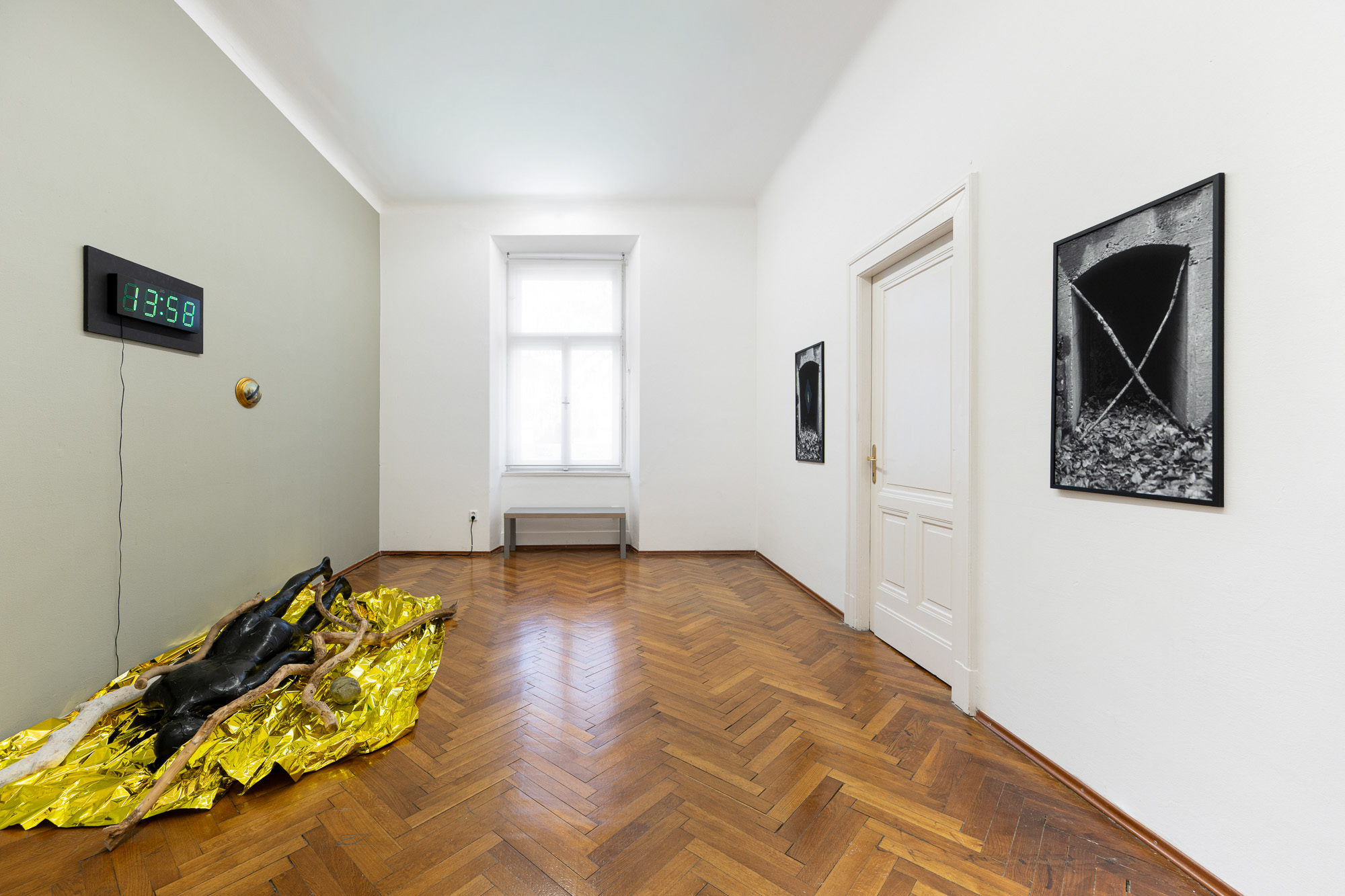
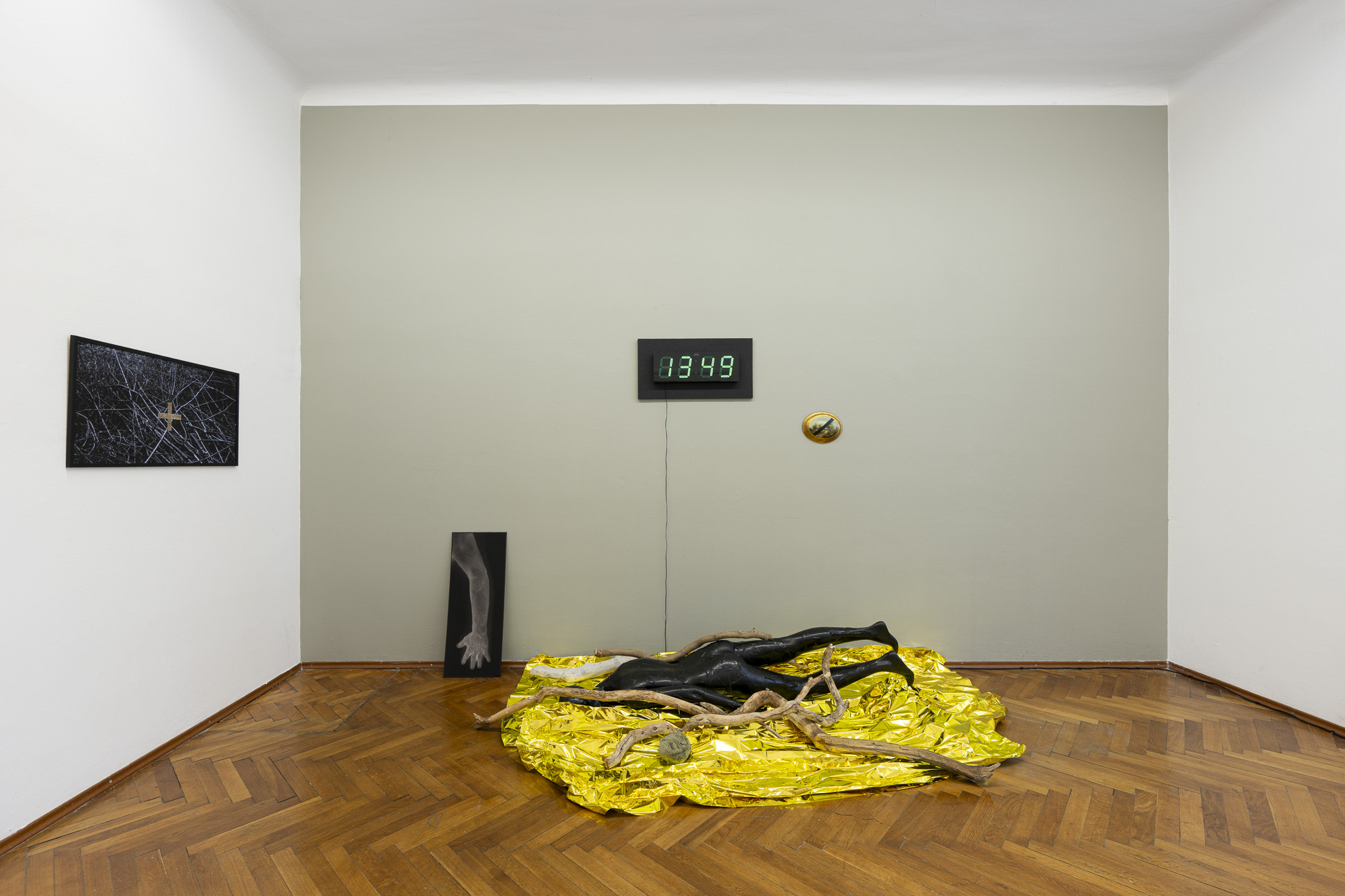
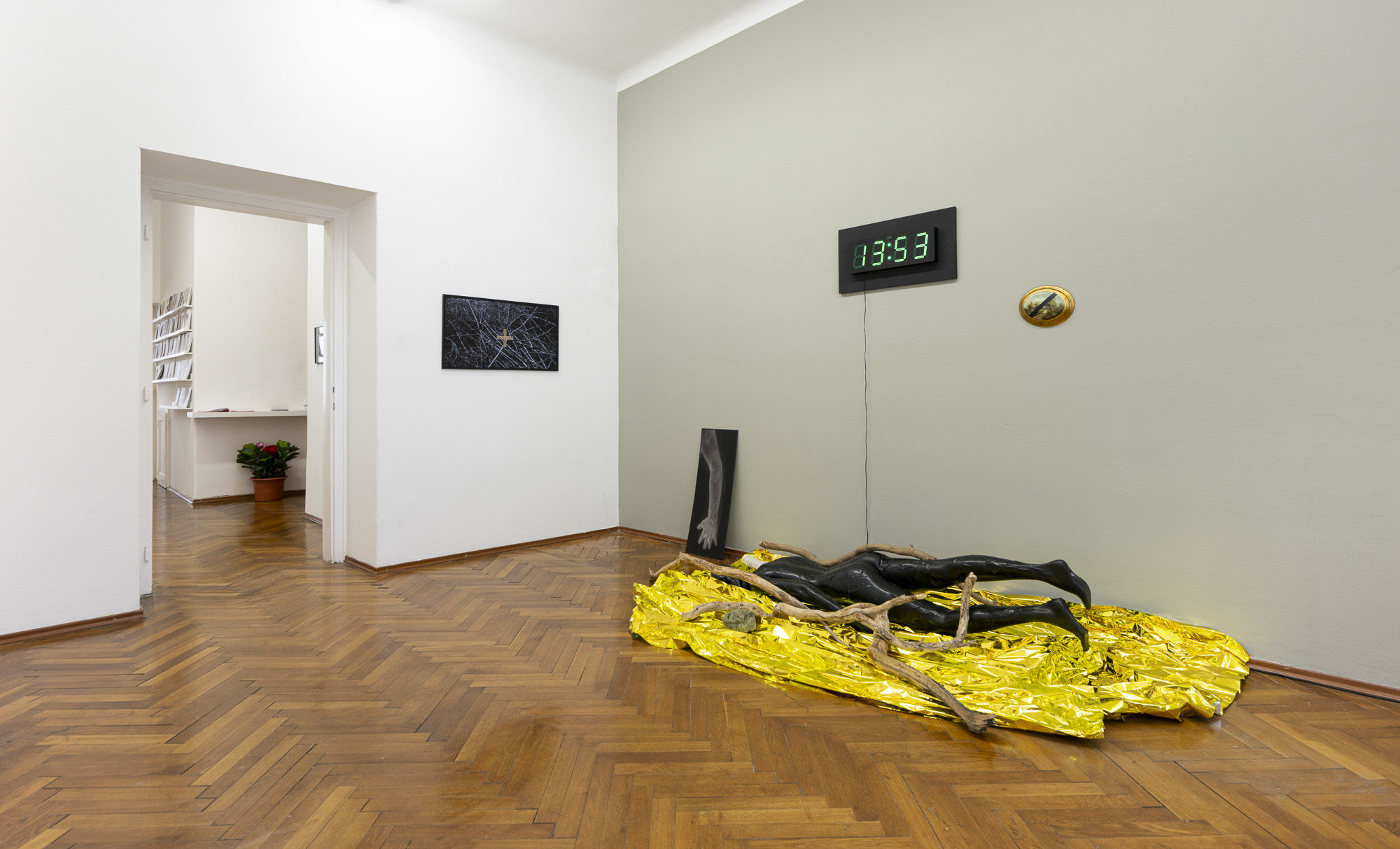
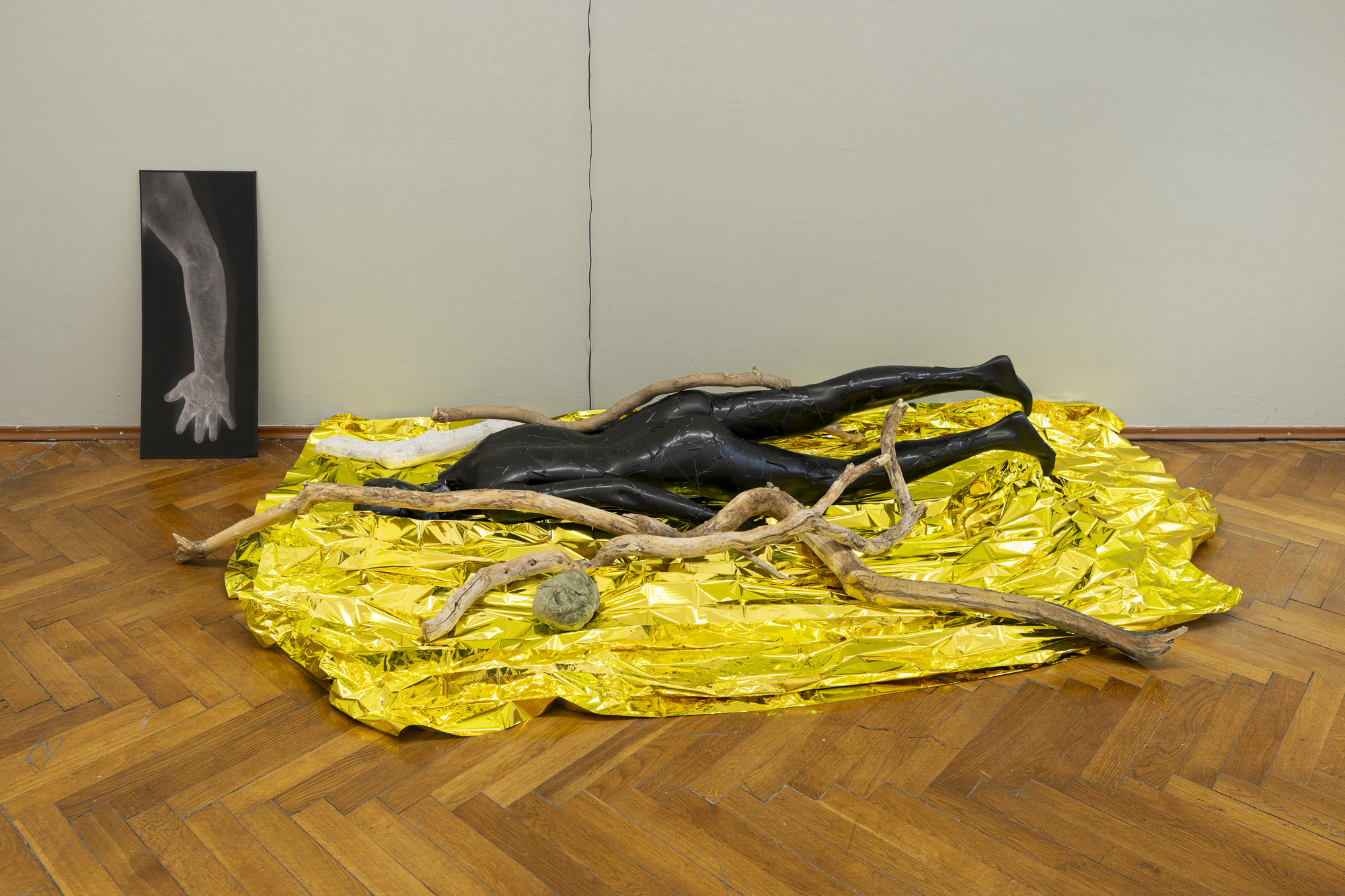
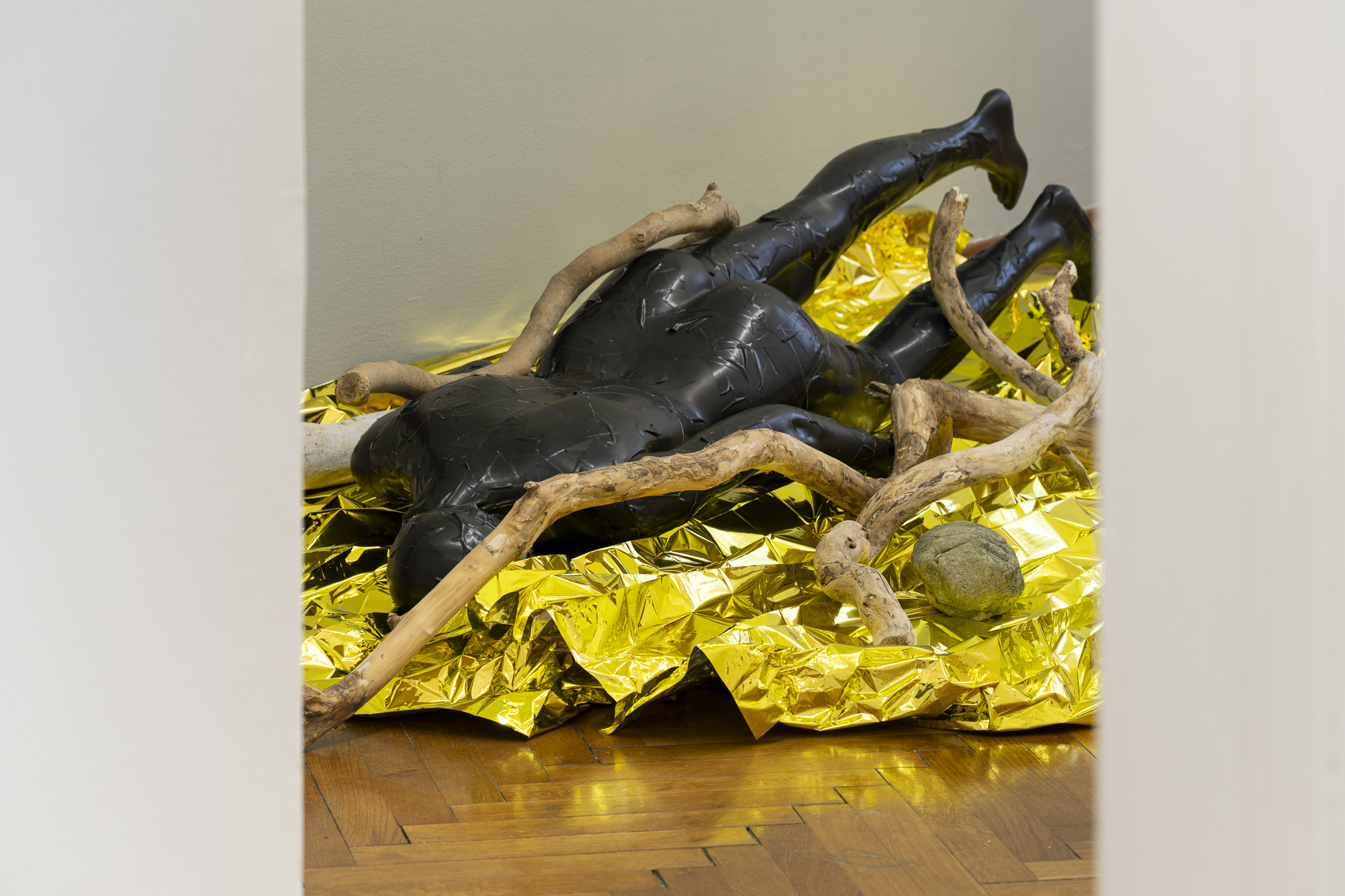
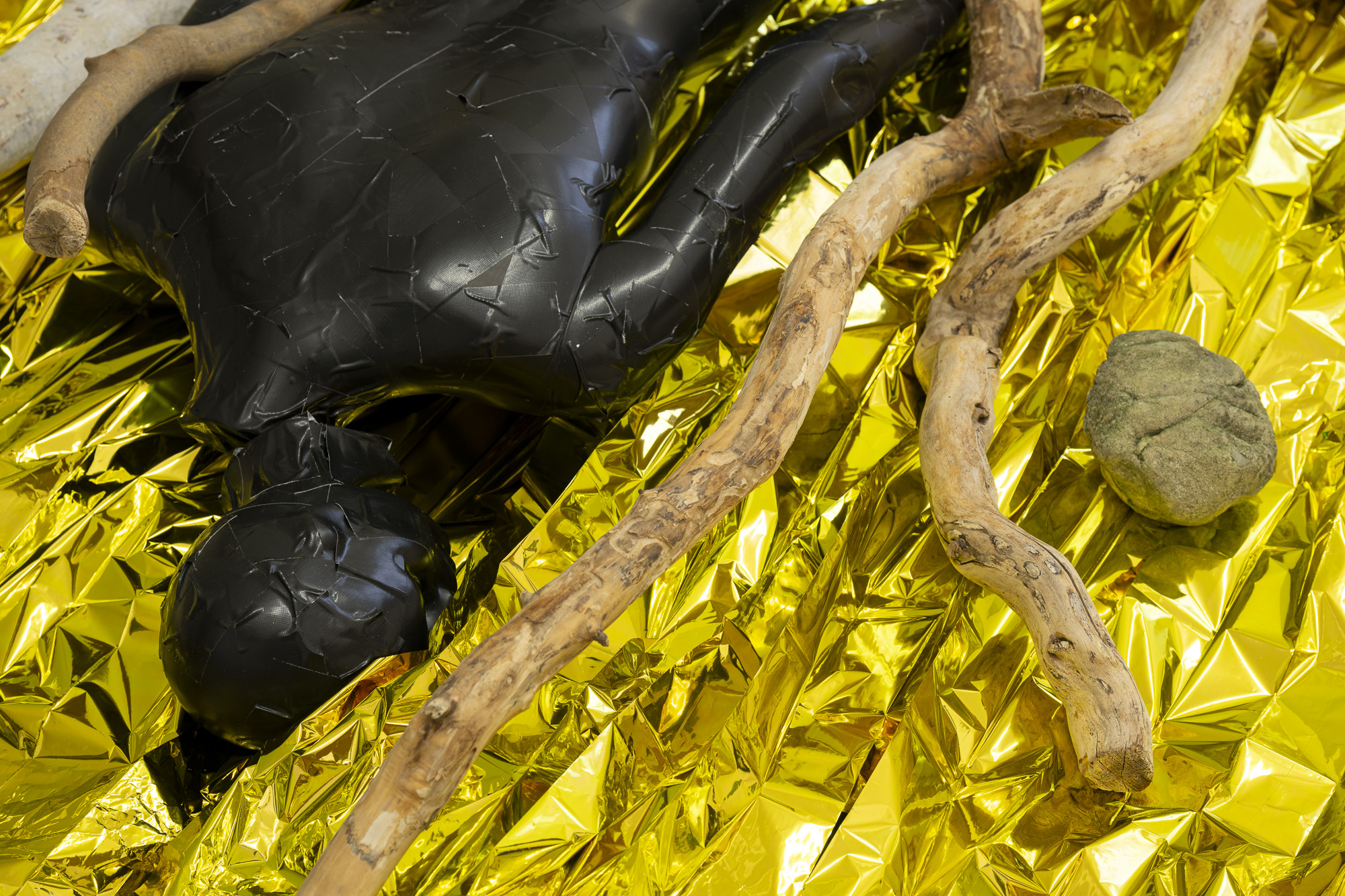
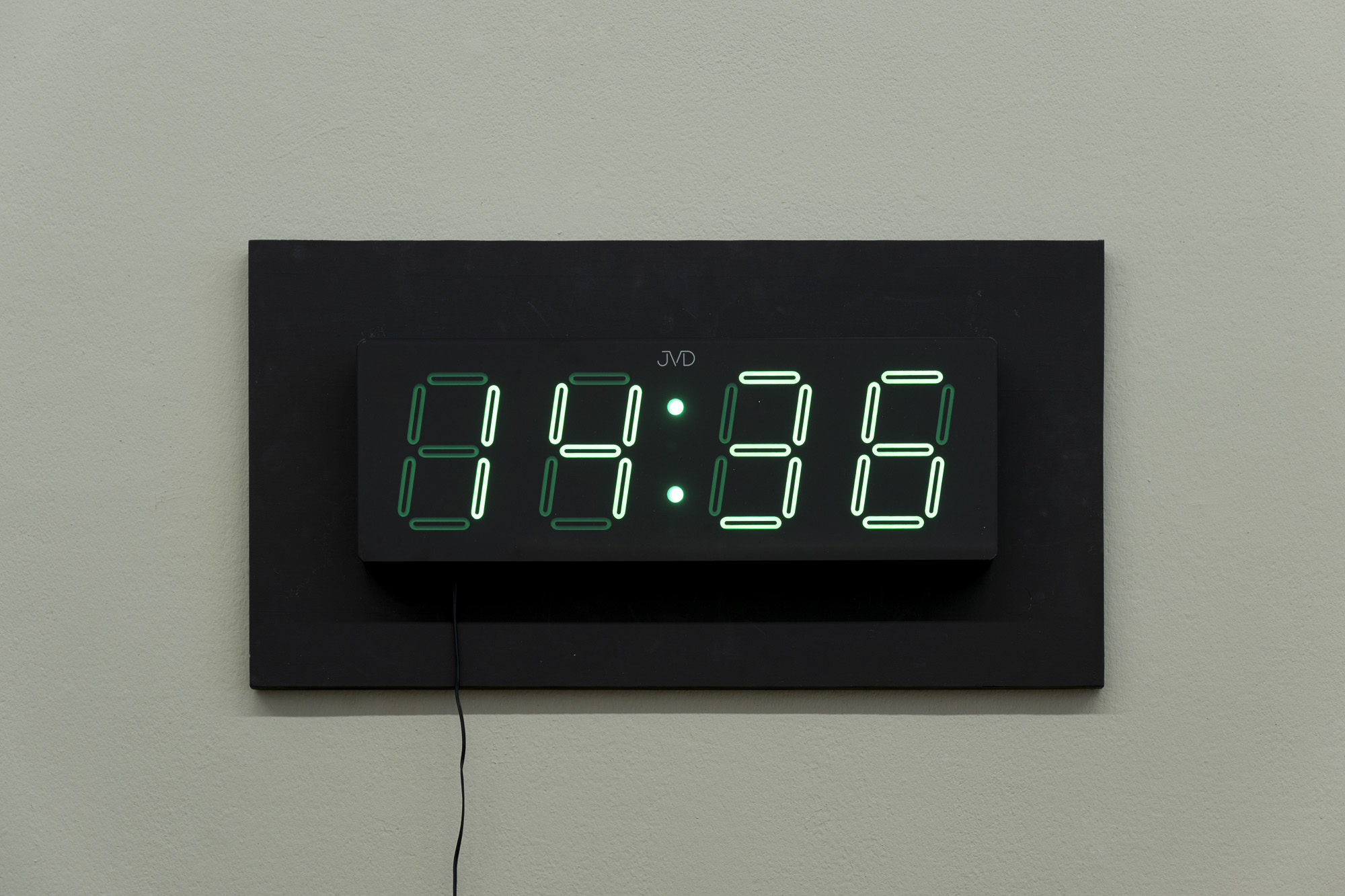
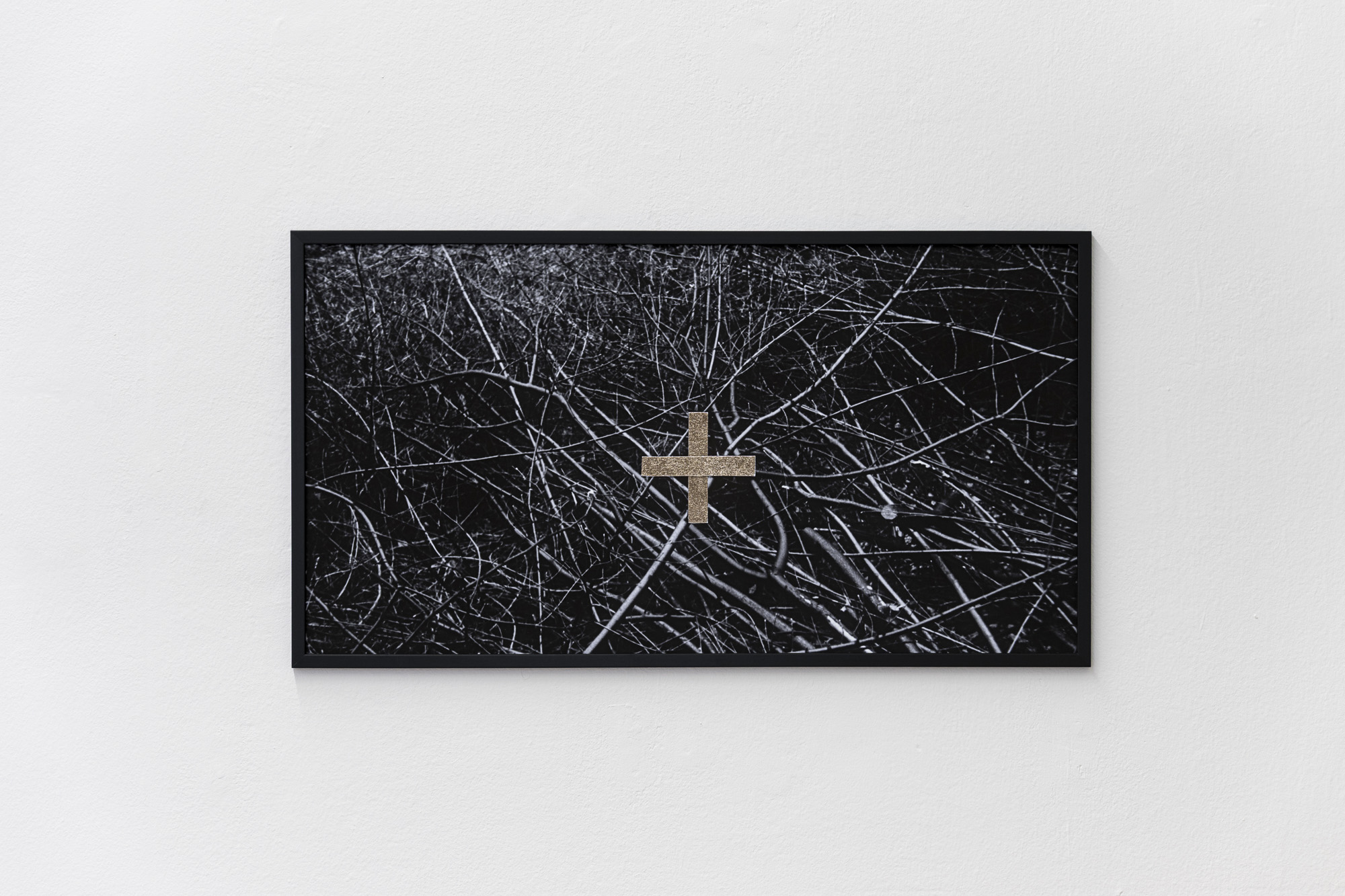
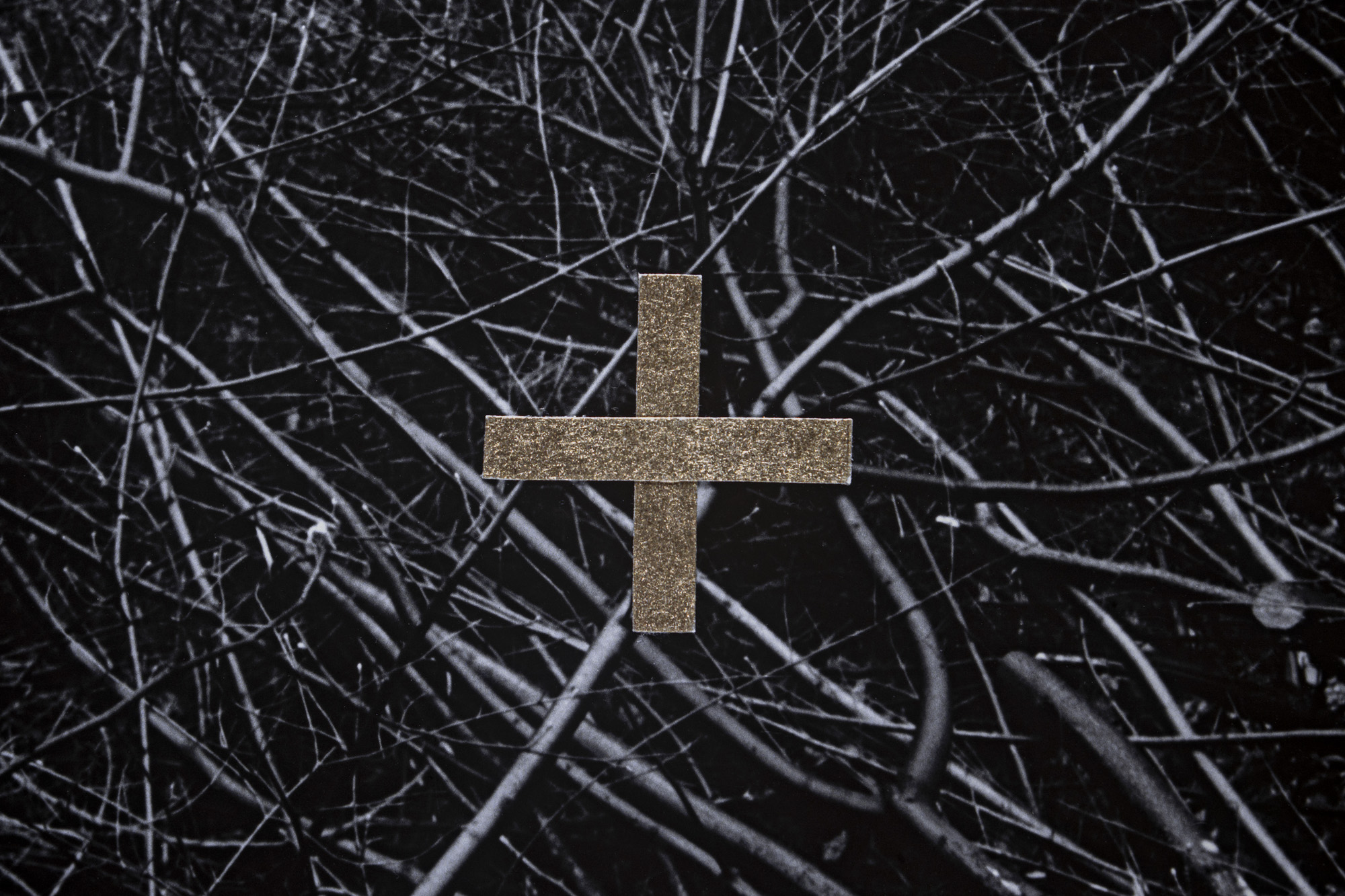
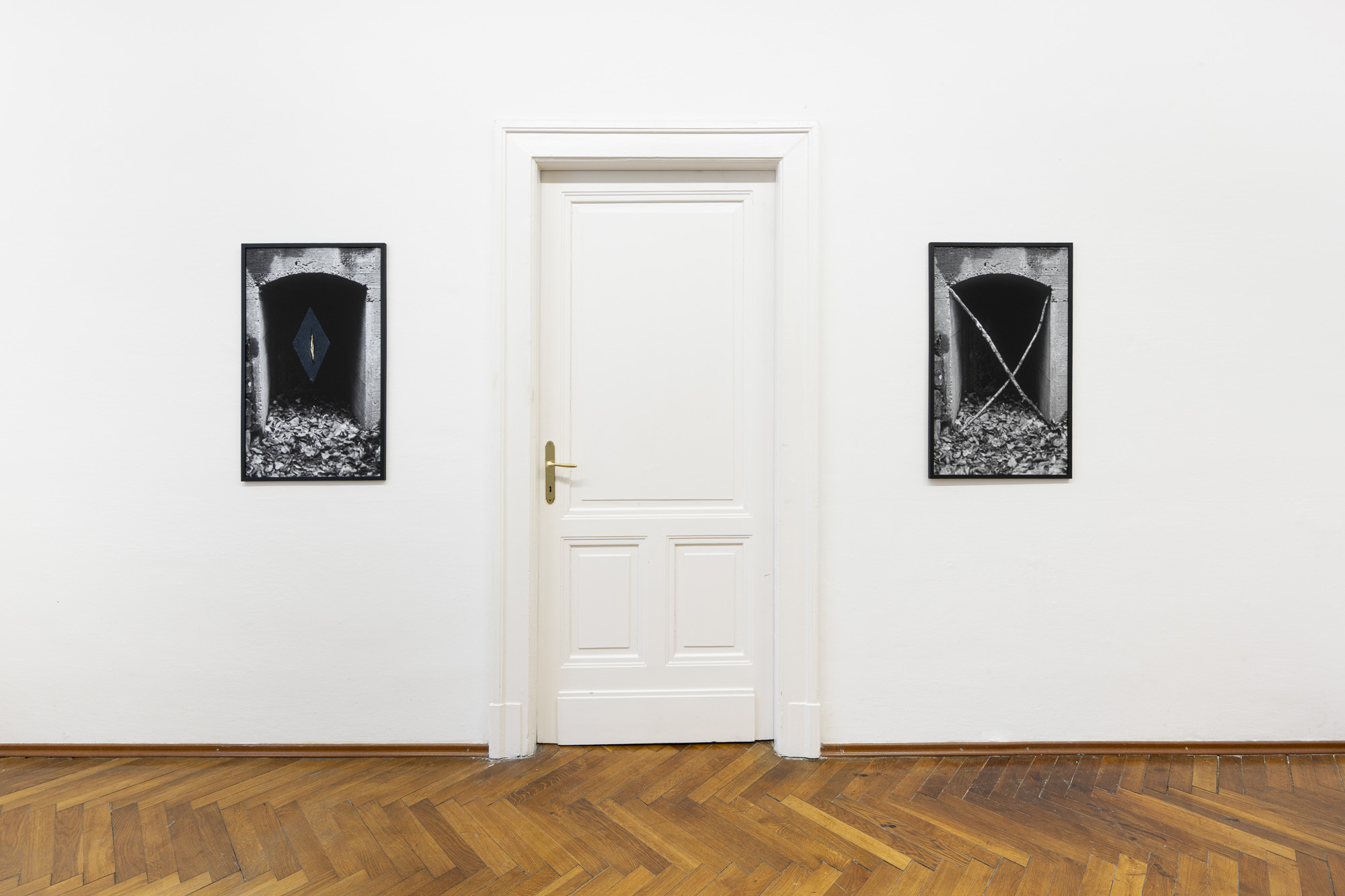
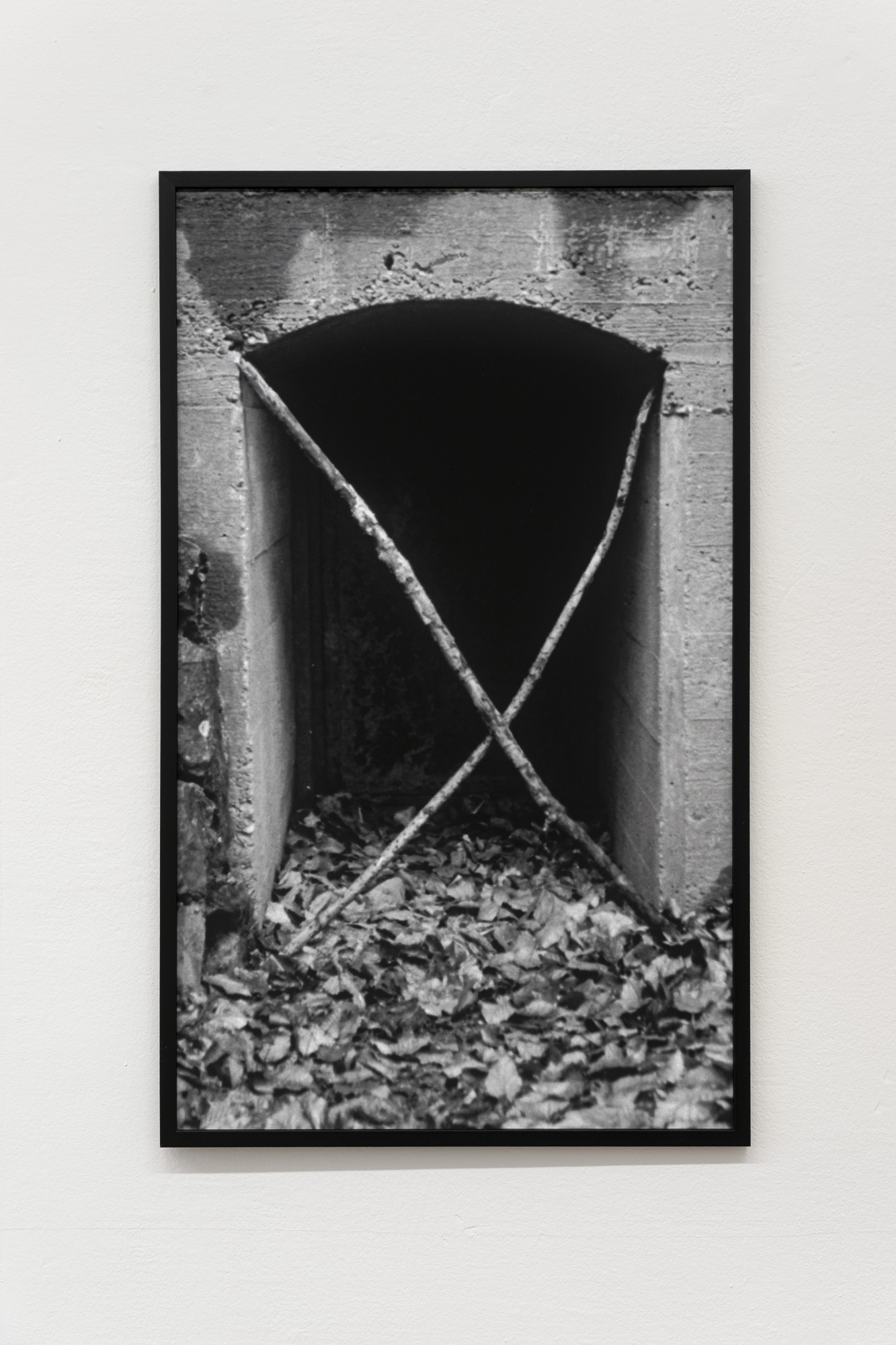
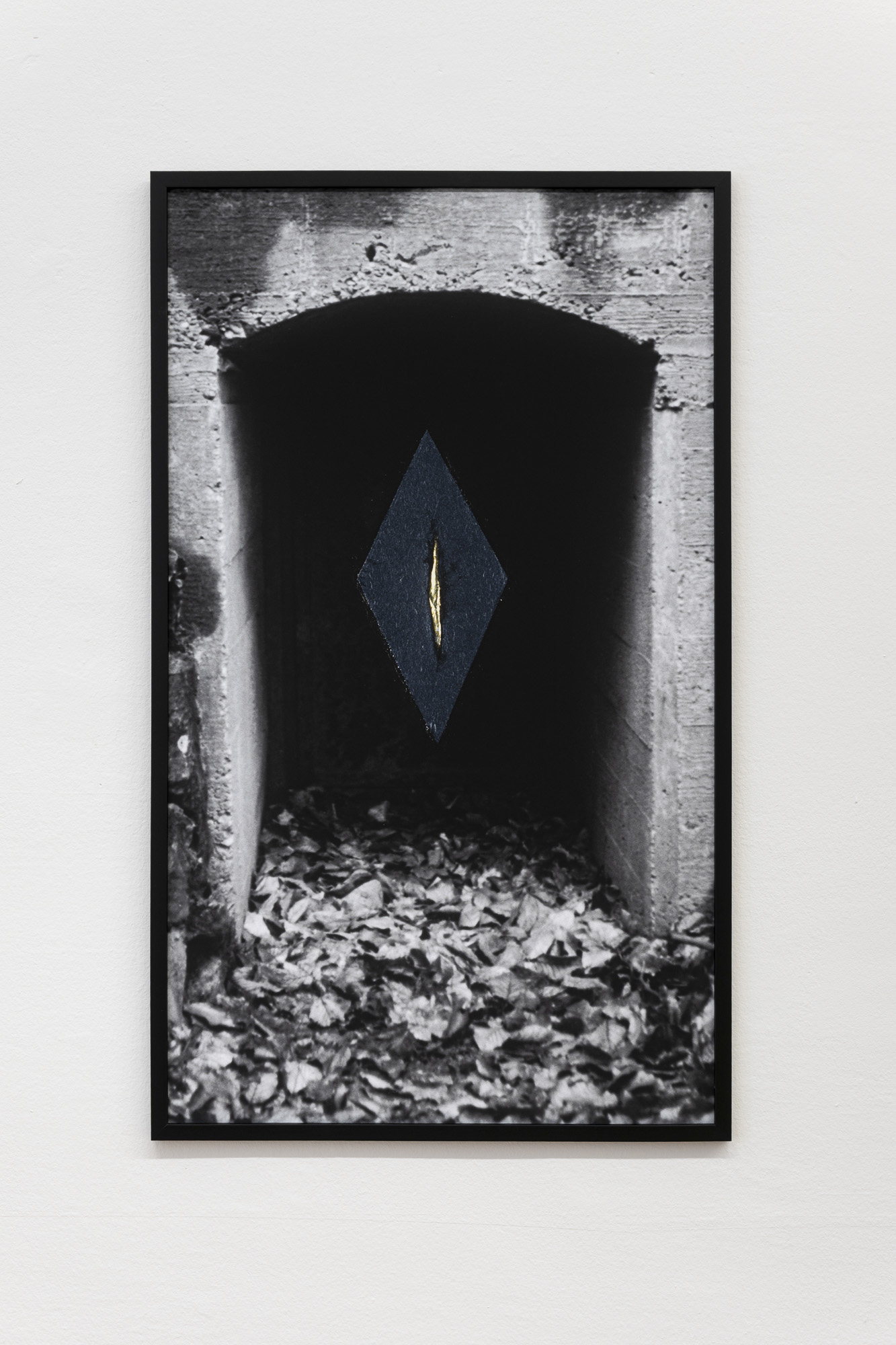
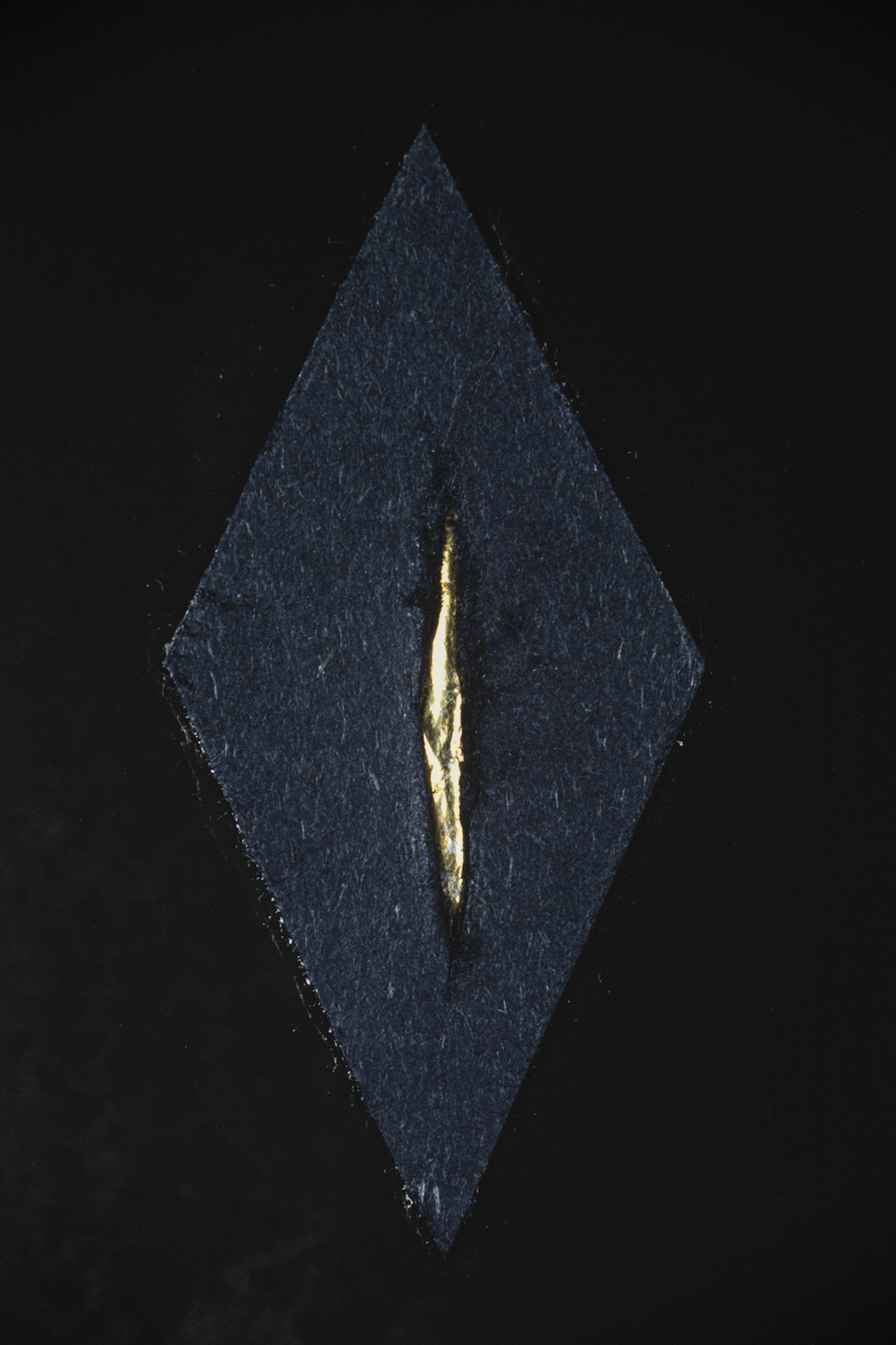
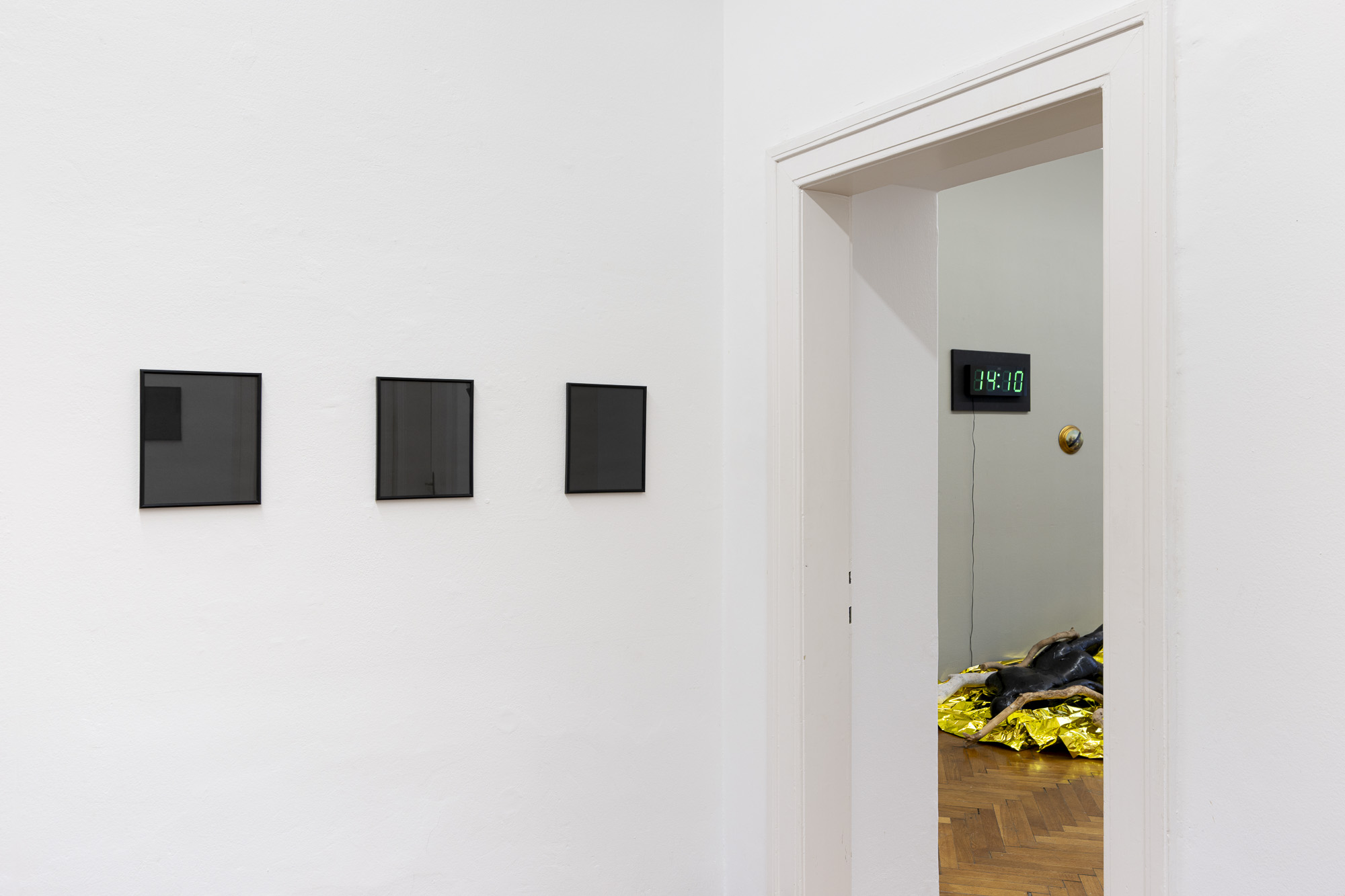
The first image emerges from the experience of wounding. The apocalyptic body of the world is female. Emergency foil, as a material for urgent care, also conveys a sense of fragility. Its golden sheen evokes a sacred layer of the scene that, in this simulacral form, activates a multitude of contradictory emotions. The digitally measured time on the wall presents another, organic time: the time of wood, of the body, of its weight and decay. This temporality is further developed in the diptych through the motif of the “beginning of the world”, the fissure of time, the sacred wound or the yoni, alongside the artist’s characteristic motif of the “prohibition of touch” — the impossibility of entering, passing through, and continuing. Želibská has created a constellation in which body, object, and sign become bearers of a shared affective field. Black, gold, wood, and various symbols generate visual tension, but also an experience of the present as a space of care and wounding, control and escape.
Second image: Where is our sister?
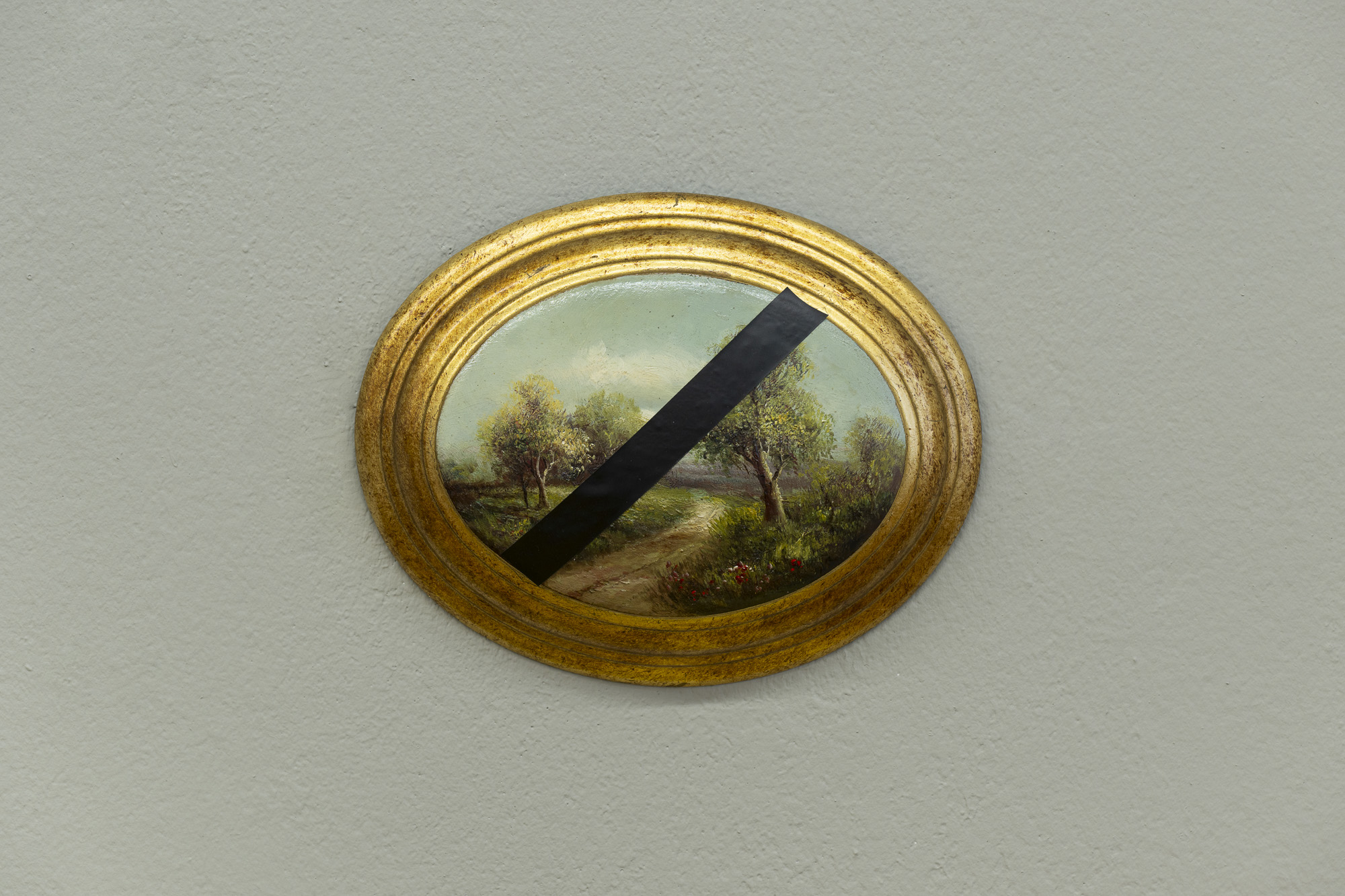
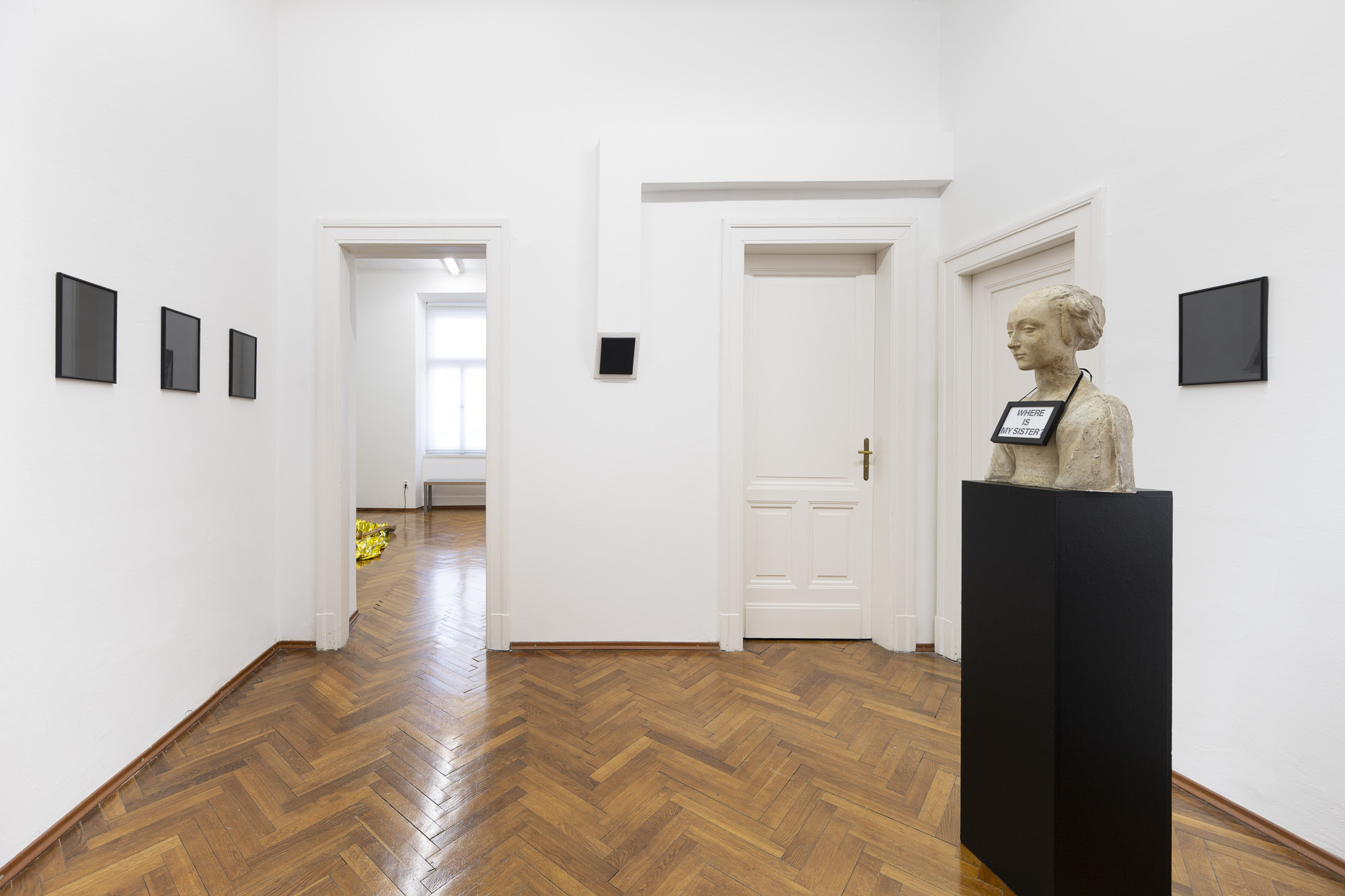
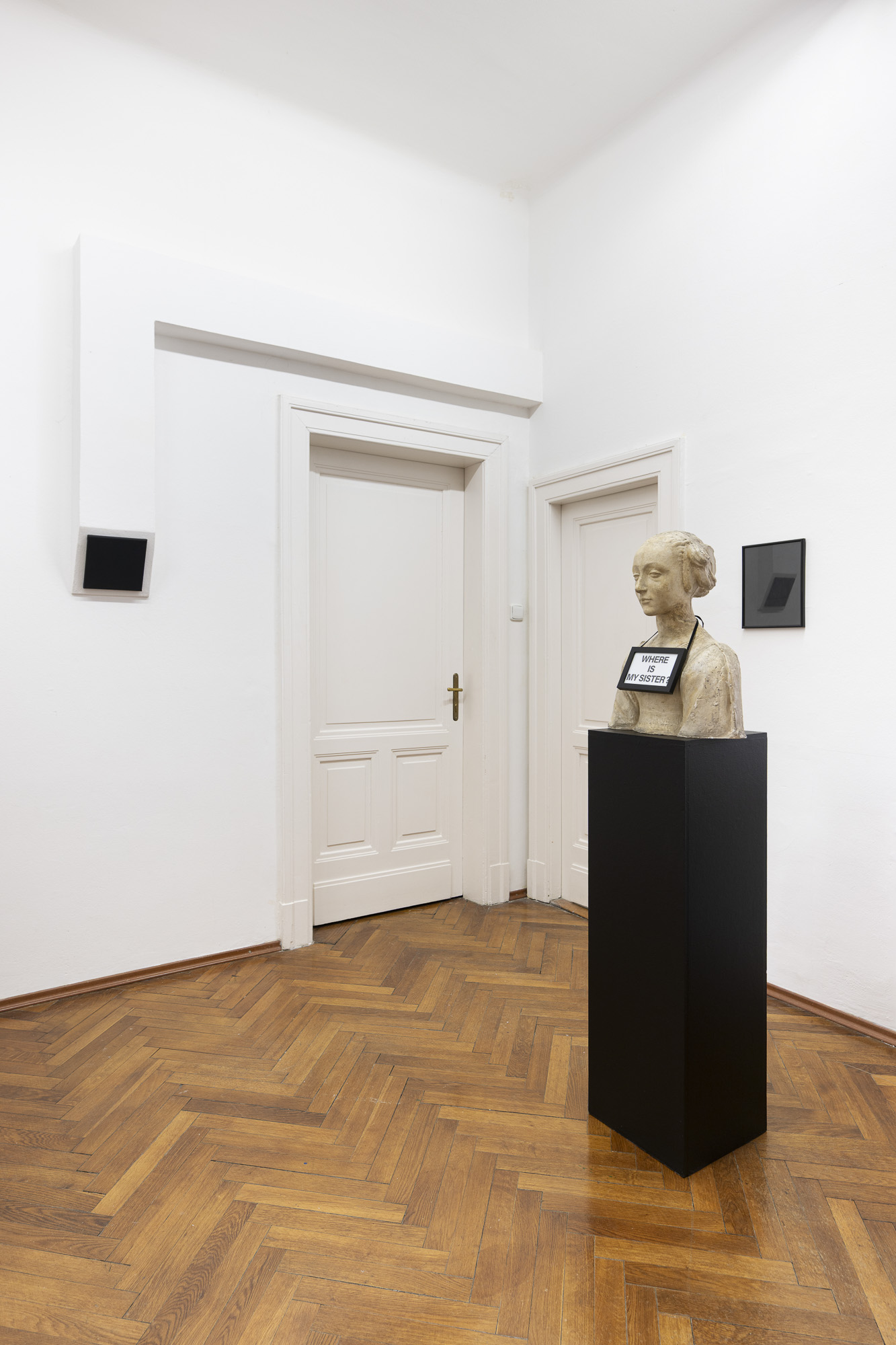
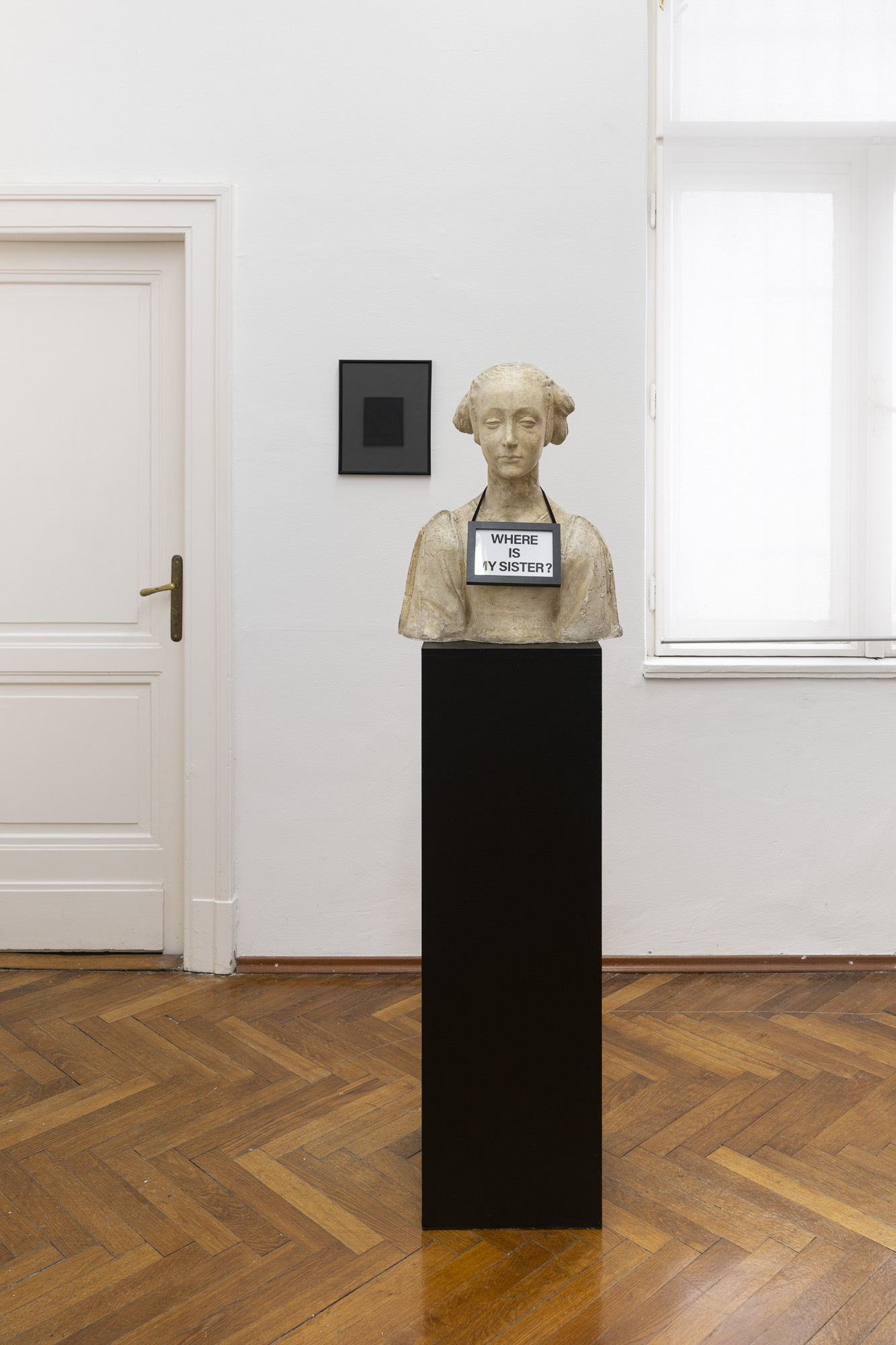
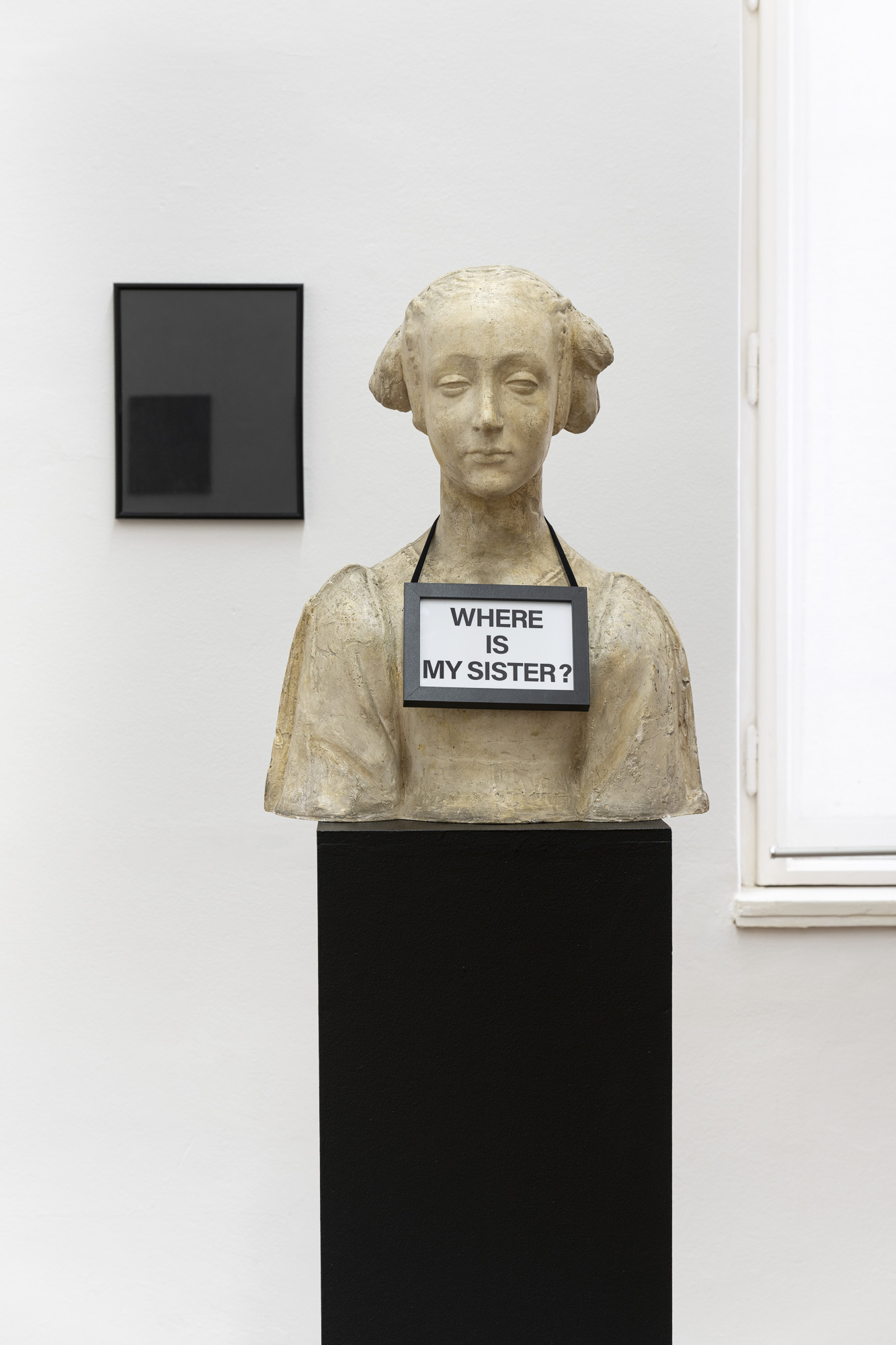
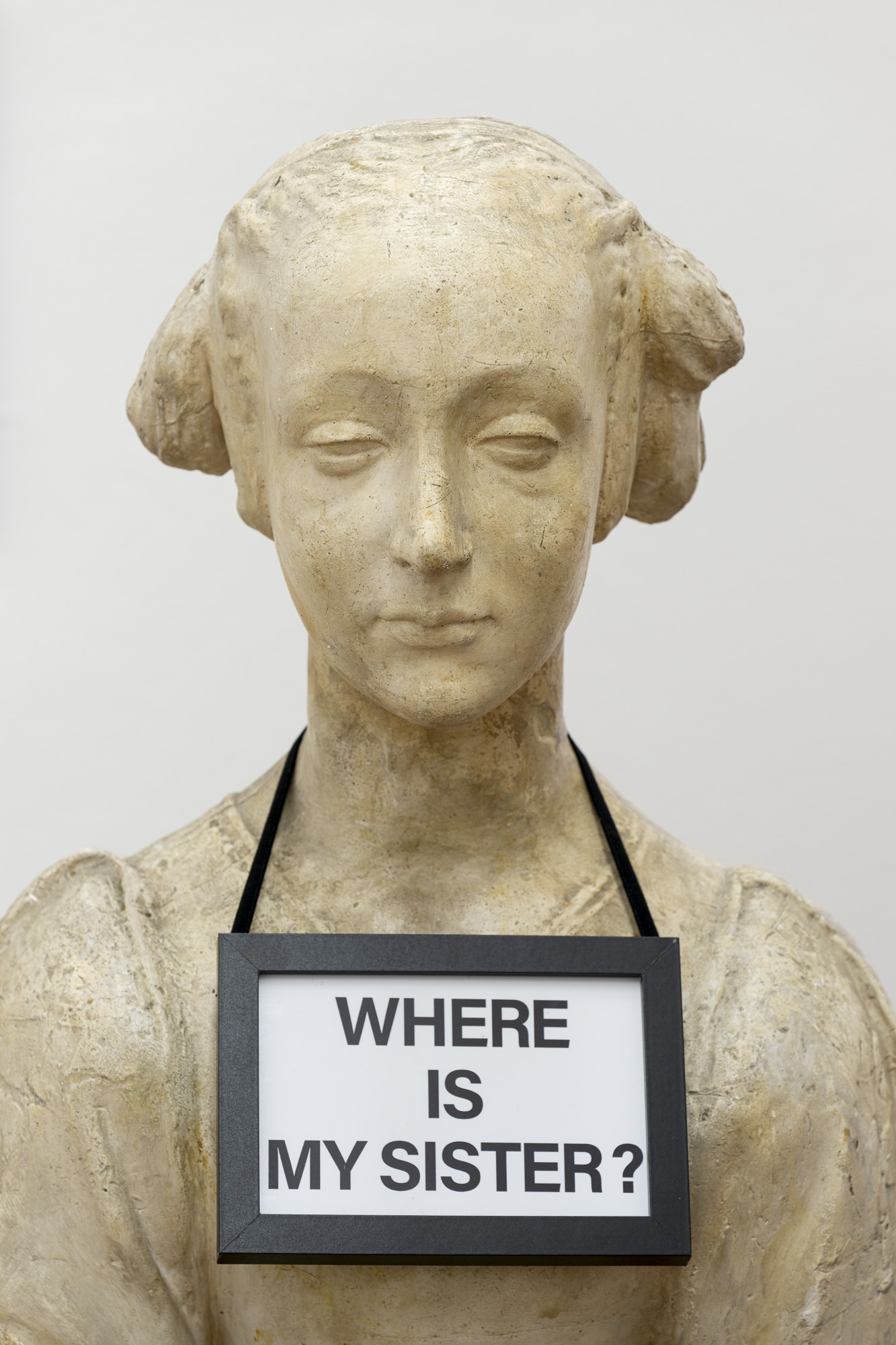
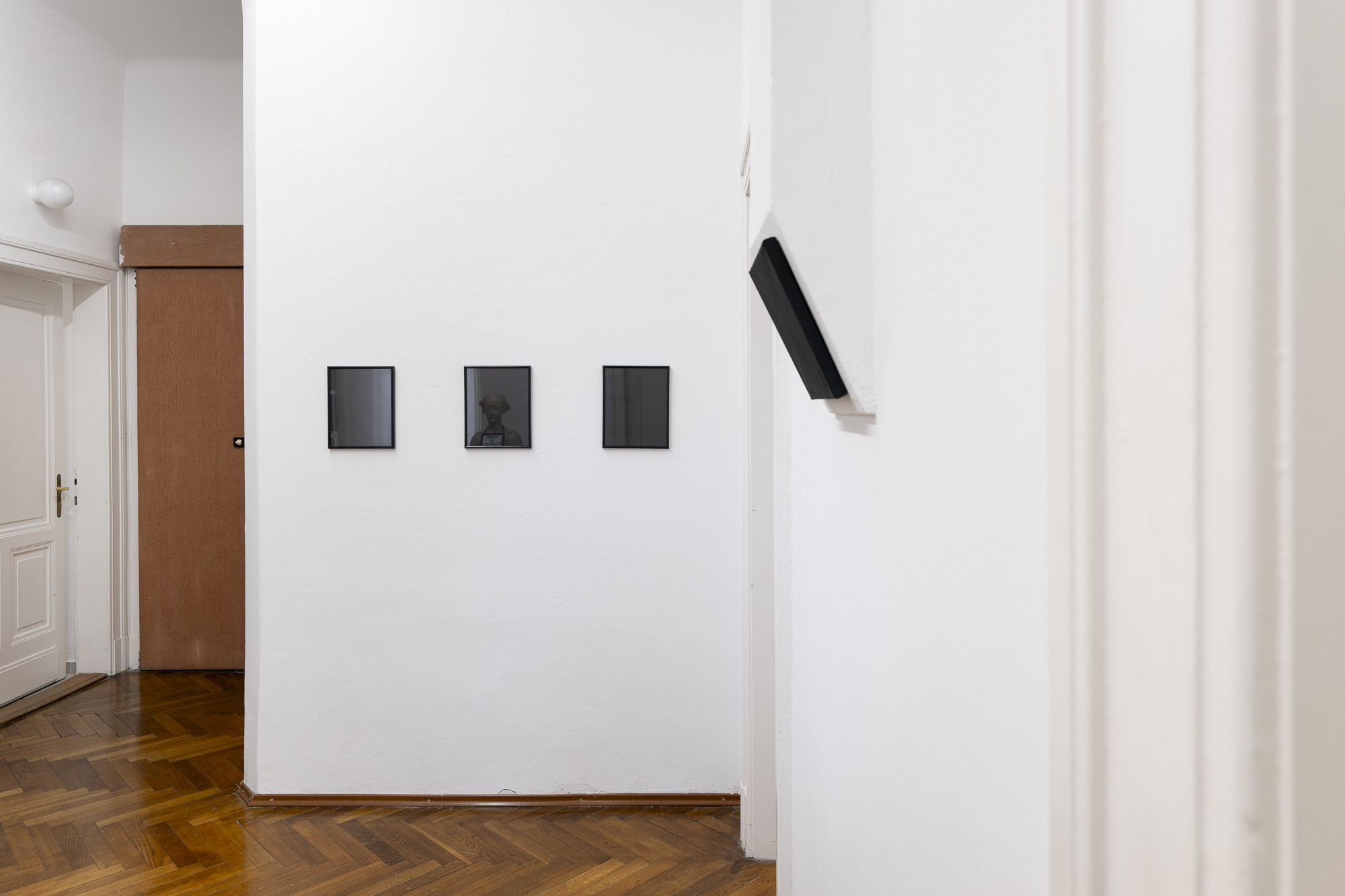
The second image forms the exhibition’s cultural, political, and symbolic knot. At its center stands the object of the “sister”, through which Želibská activates historical imagery — not only female imagery — as well as cultural memory, care, and public responsibility. The plaster bust, which the artist had already used in the installation Amateur contra Renaissance (1989) and to which she returns again in this exhibition, enters into a powerful relation of meaning with the story of the Levoča bust attributed to Cecilia Gonzaga.[2] It is precisely through this transfer that the exhibition space concentrates the conflict between scholarship and propaganda, between scholarly continuity and political intervention, between care as a principle and the unbearably simplified public handling of a complex cultural and art-historical problem.[3]
The issue did not concern only whether the bust was an “original” or a “copy”, nor a simple “yes” or “no”. Framed in this way, the matter produced a false situation that radically oversimplified the entire problem. It vulgarized and, in the eyes of the public, devalued cultural and art-historical research, whose value lies not only in a single final verdict, but also in its very capacity to produce new readings of a period, a place, relations, cultural ties and contexts. This very web of nuances and information constitutes a value in itself: it is a space of knowledge in which the work becomes not merely an object of identification, but a node of historical imagination, (inter)cultural relations, and a new interpretation of both past and present.
The situation surrounding the Levoča bust thus revealed a fundamental conflict between long-term scholarly work and an administrative gesture, between culture as a space of subtle interpretation and a form of power that needs to accelerate, simplify, and close it down — to instrumentalize, devalue, and violently appropriate it. It is precisely in this sense that the Levoča Cecilia has become the face of the present struggle over values and over the space of culture in Slovakia.
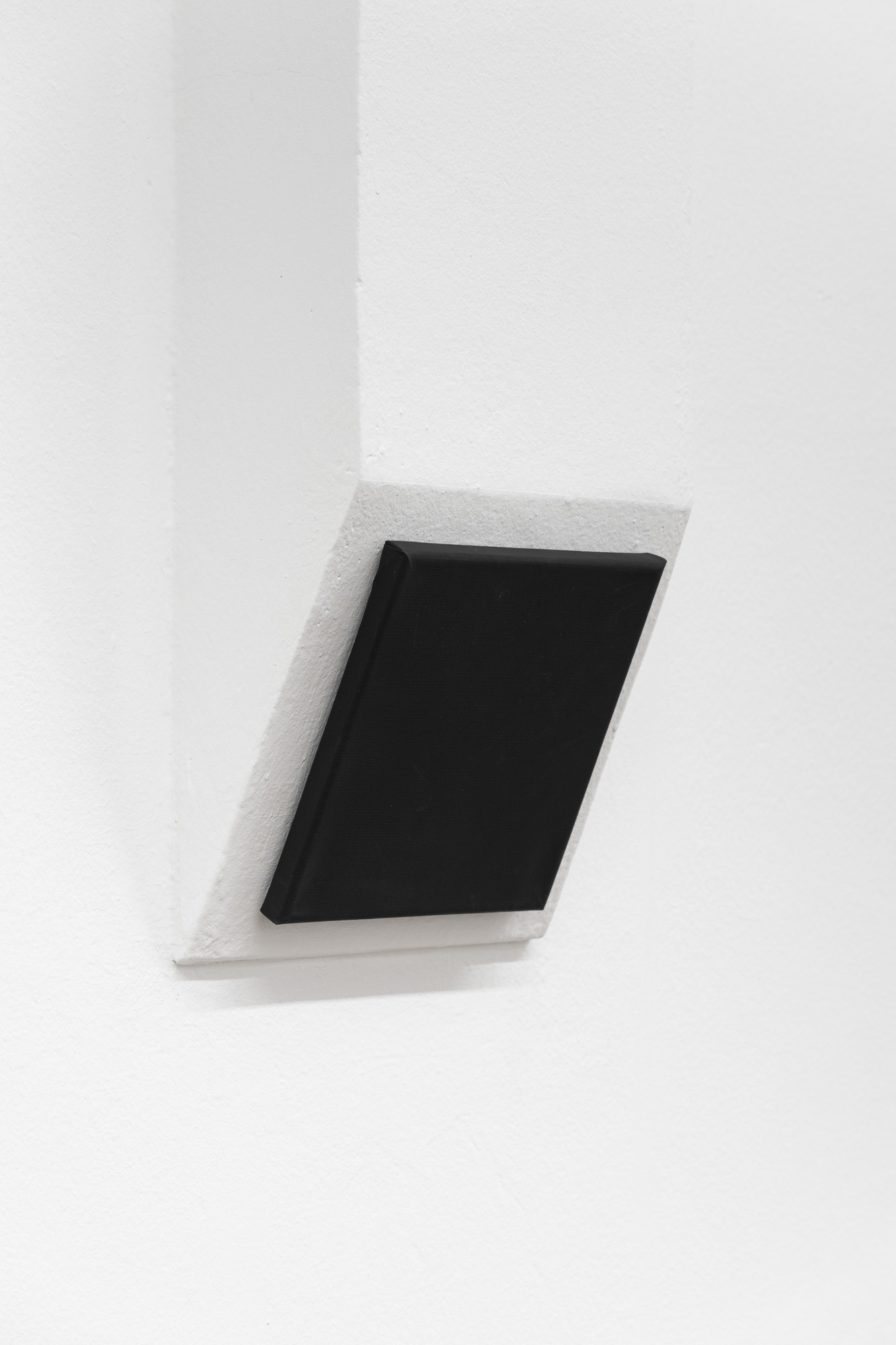
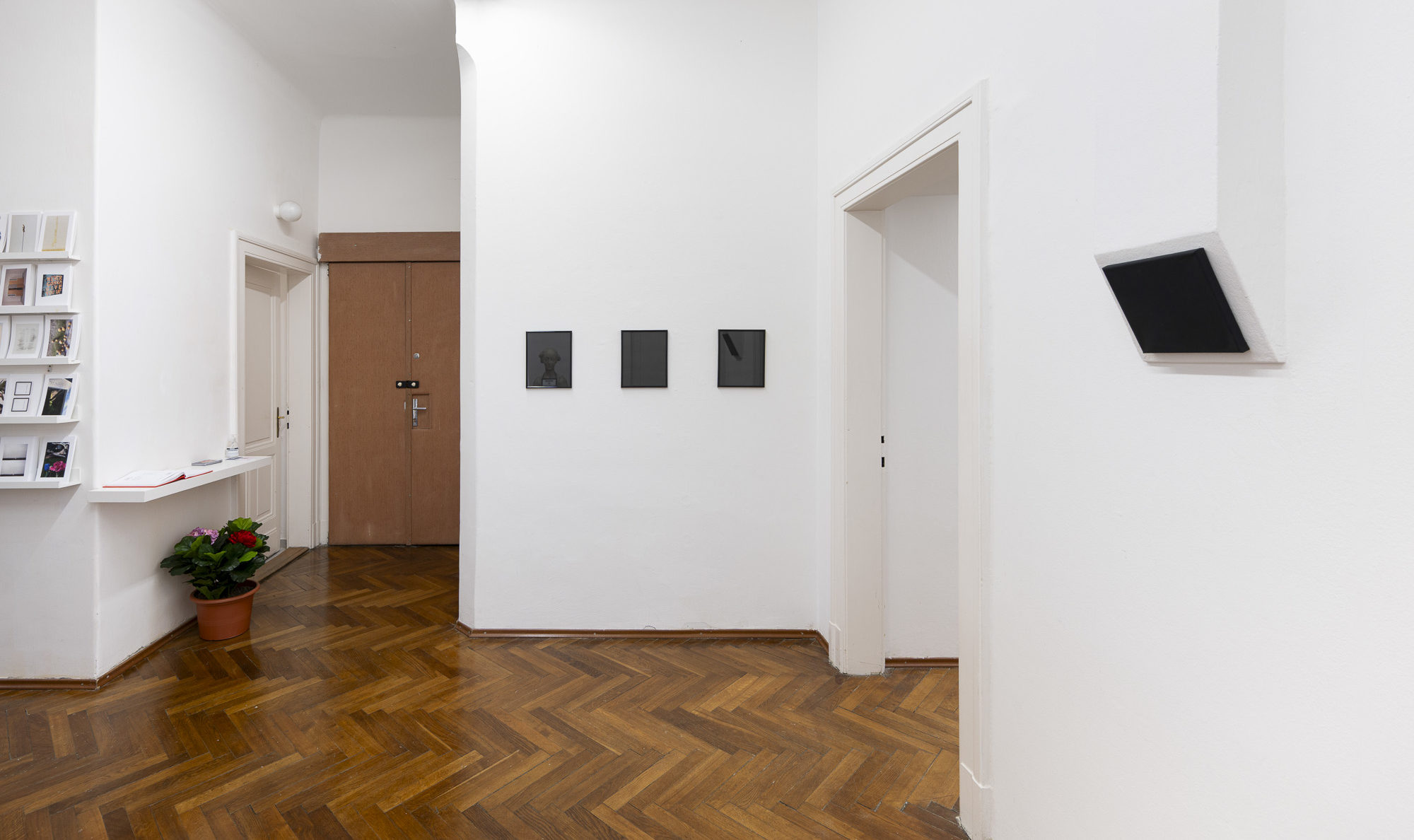
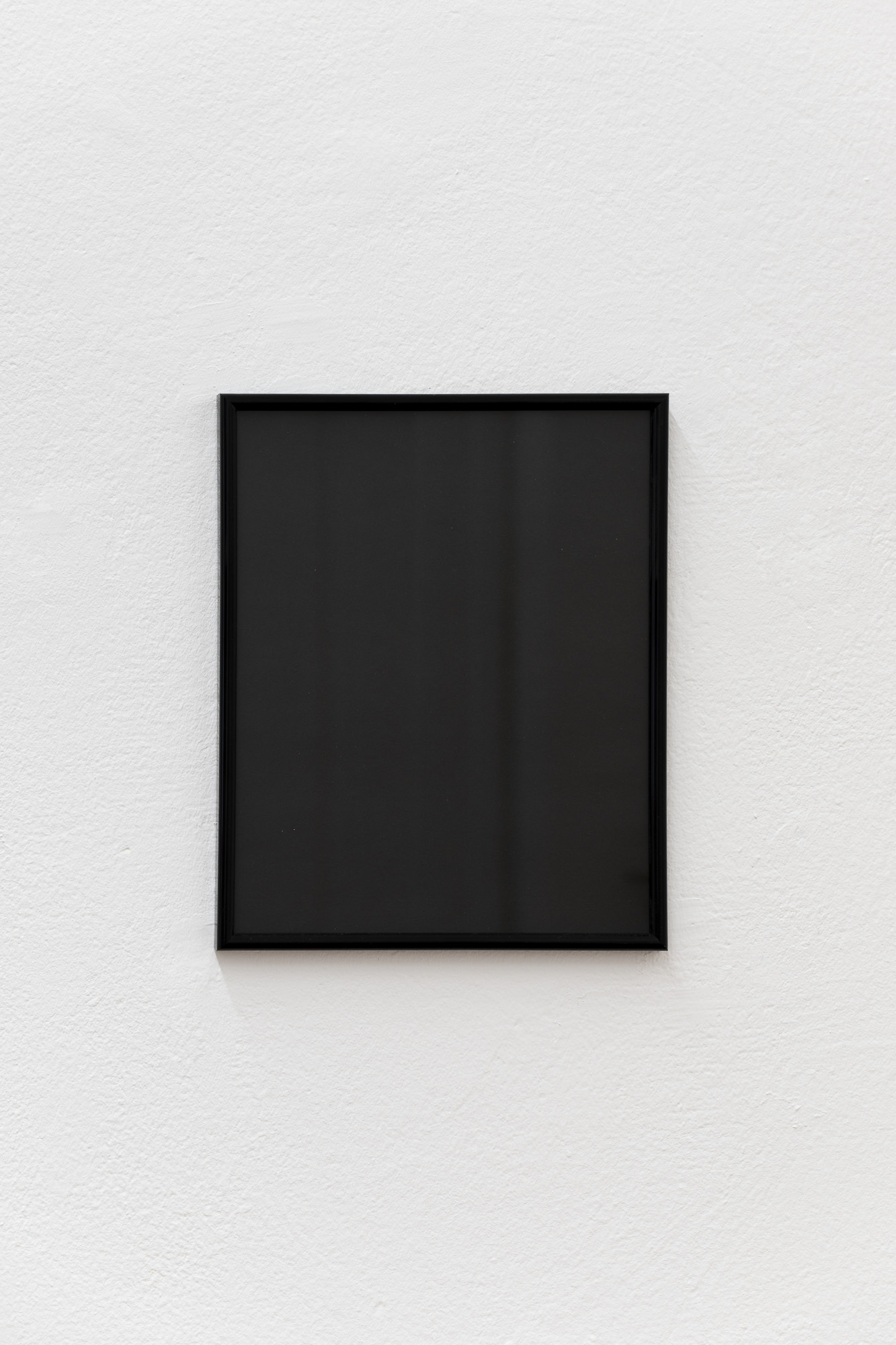
The question “WHERE IS MY SISTER?” transforms the “sister” object into the living voice of a woman, calling for solidarity and sisterhood while also appealing for the awakening of civic consciousness. The “sister” becomes the central figure embodying a culture exposed to uncertainty and to a struggle over interpretation. The found icon, resonating with Malevich’s avant-garde zero point — the “black square on a white ground” — together with the darkened framed images, creates a field of interrupted visibility, reflected gazes, and zones of uncertainty. The historicity of works from the past enters a regime of memory, forgetting, and recollection, transferring responsibility for their interpretation and meaning to the current public, to us. In this image, two mutually incompatible planes of reality meet and form a paradoxical bond. The result is a precise configuration in which absurdity functions as a form of truth. Culture itself speaks here through a historical woman and asks after its tormented sister.
Third image: Hope as the germination of the future
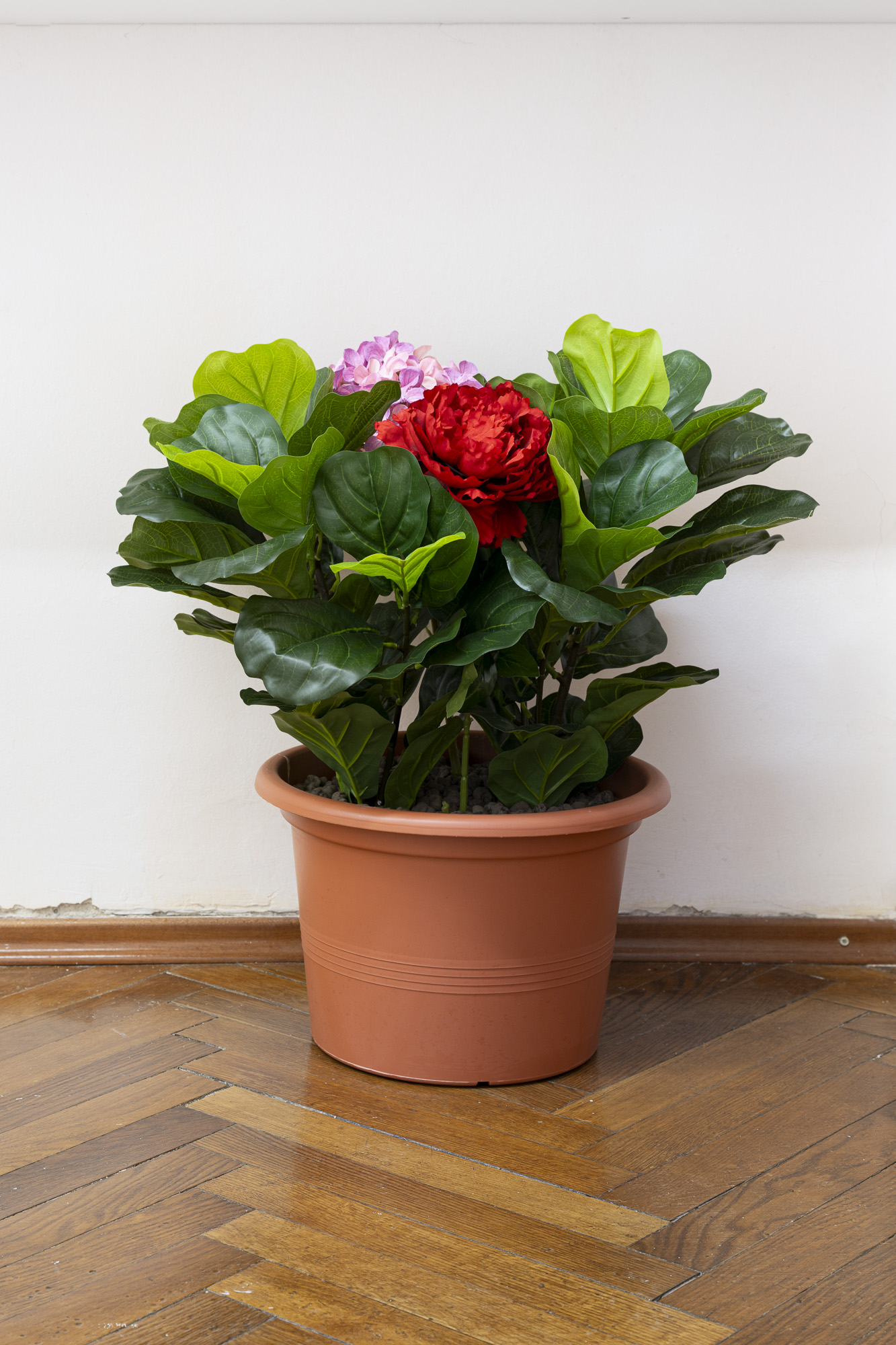
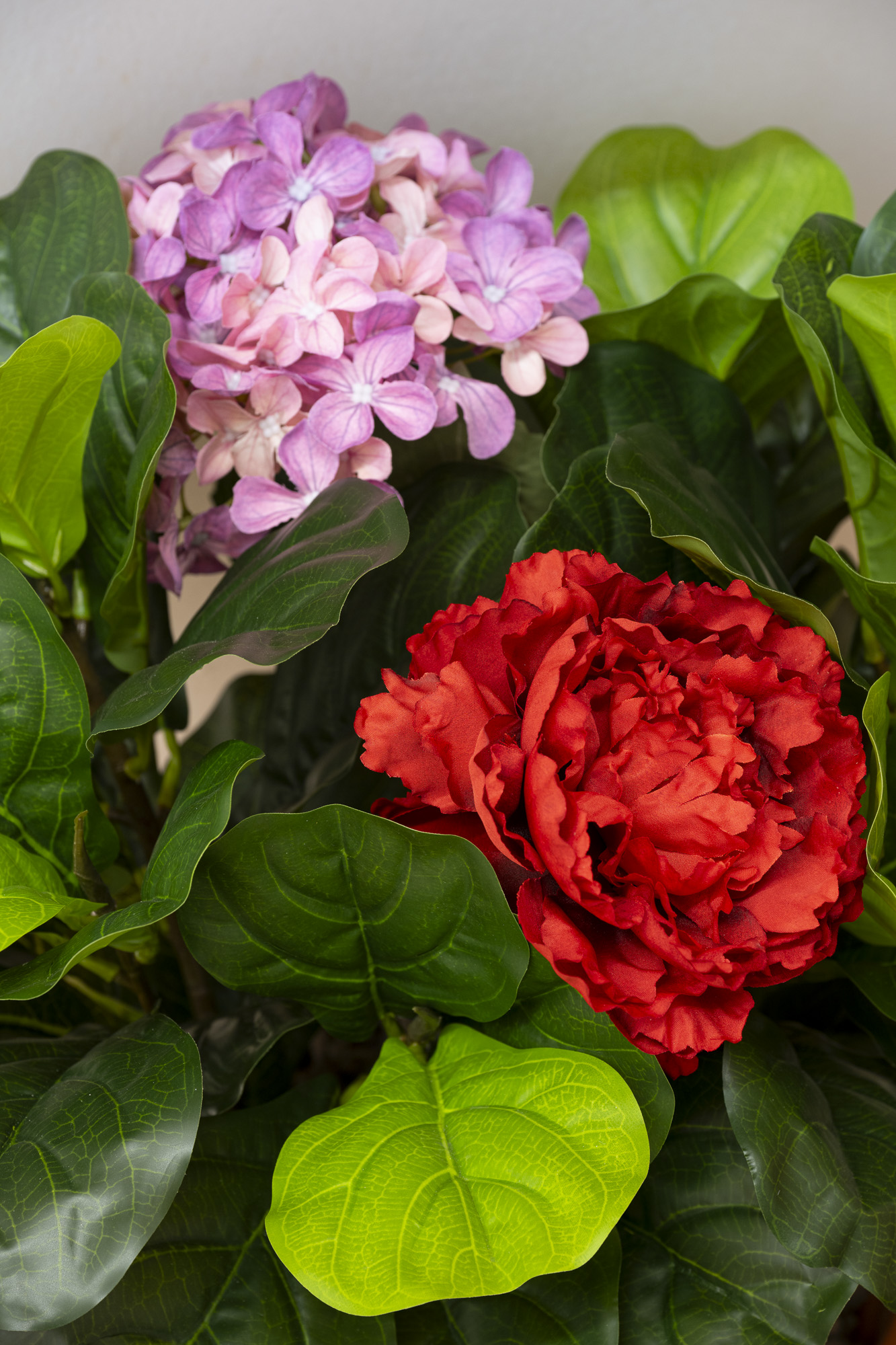
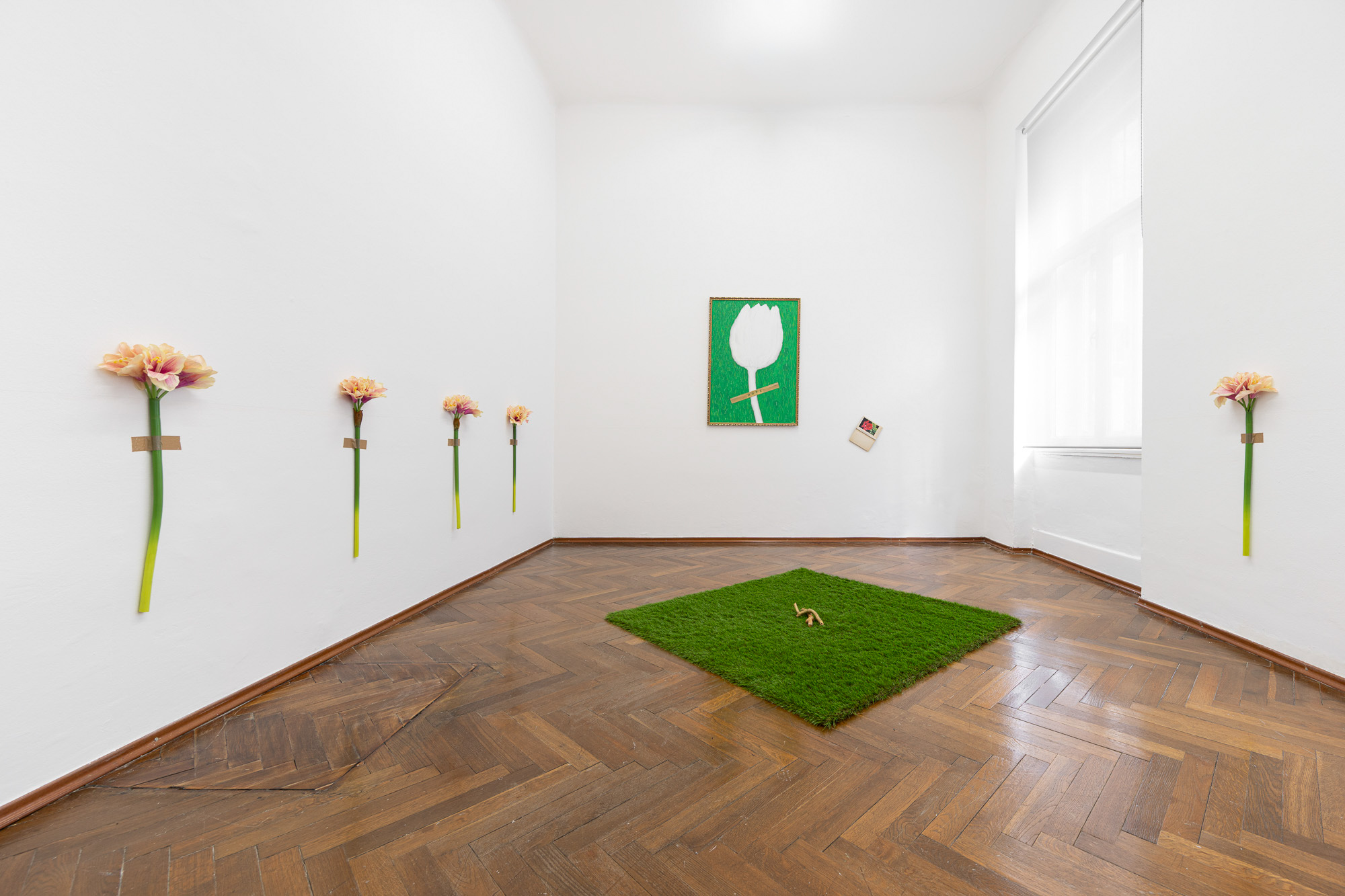
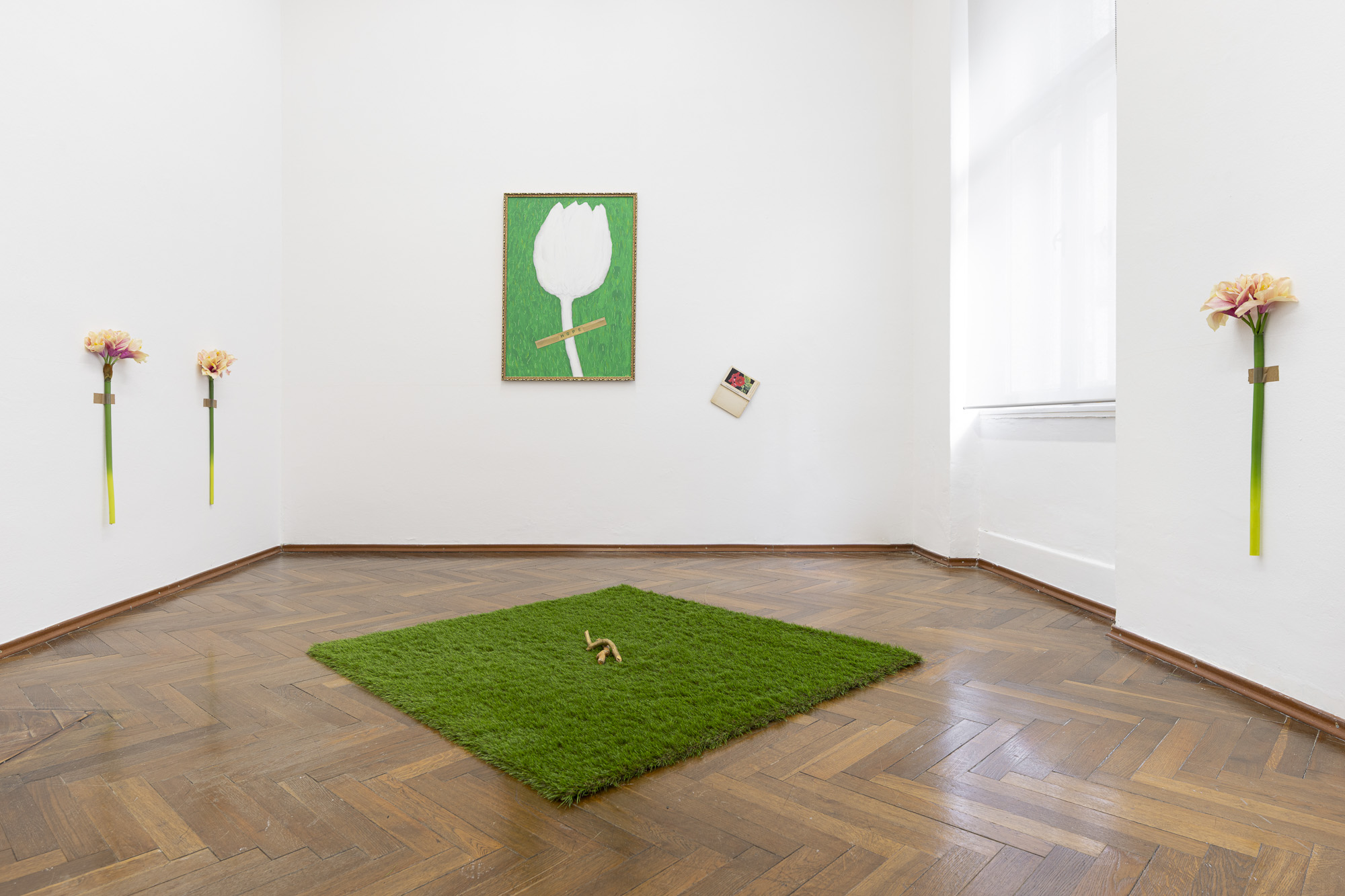
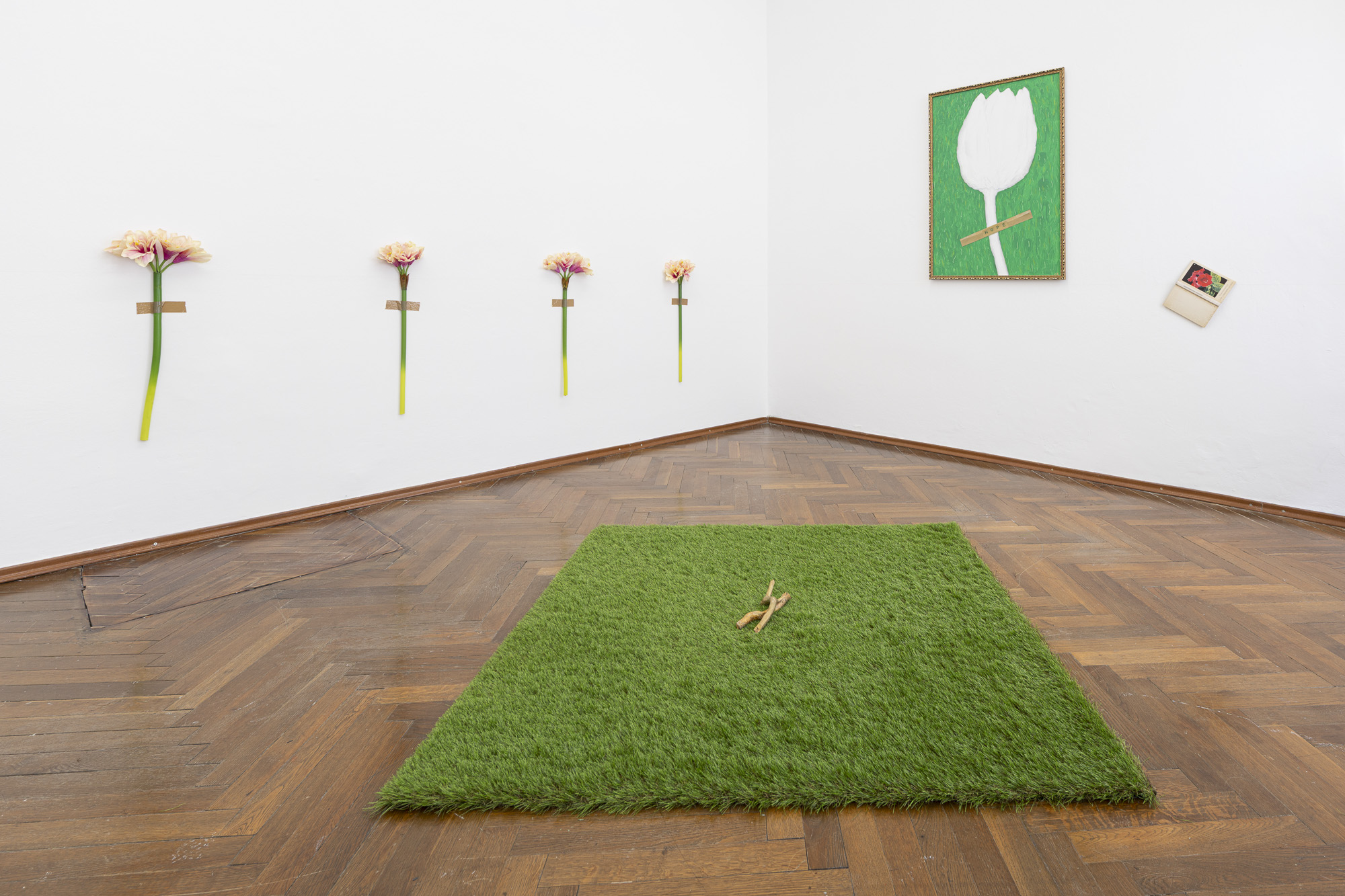
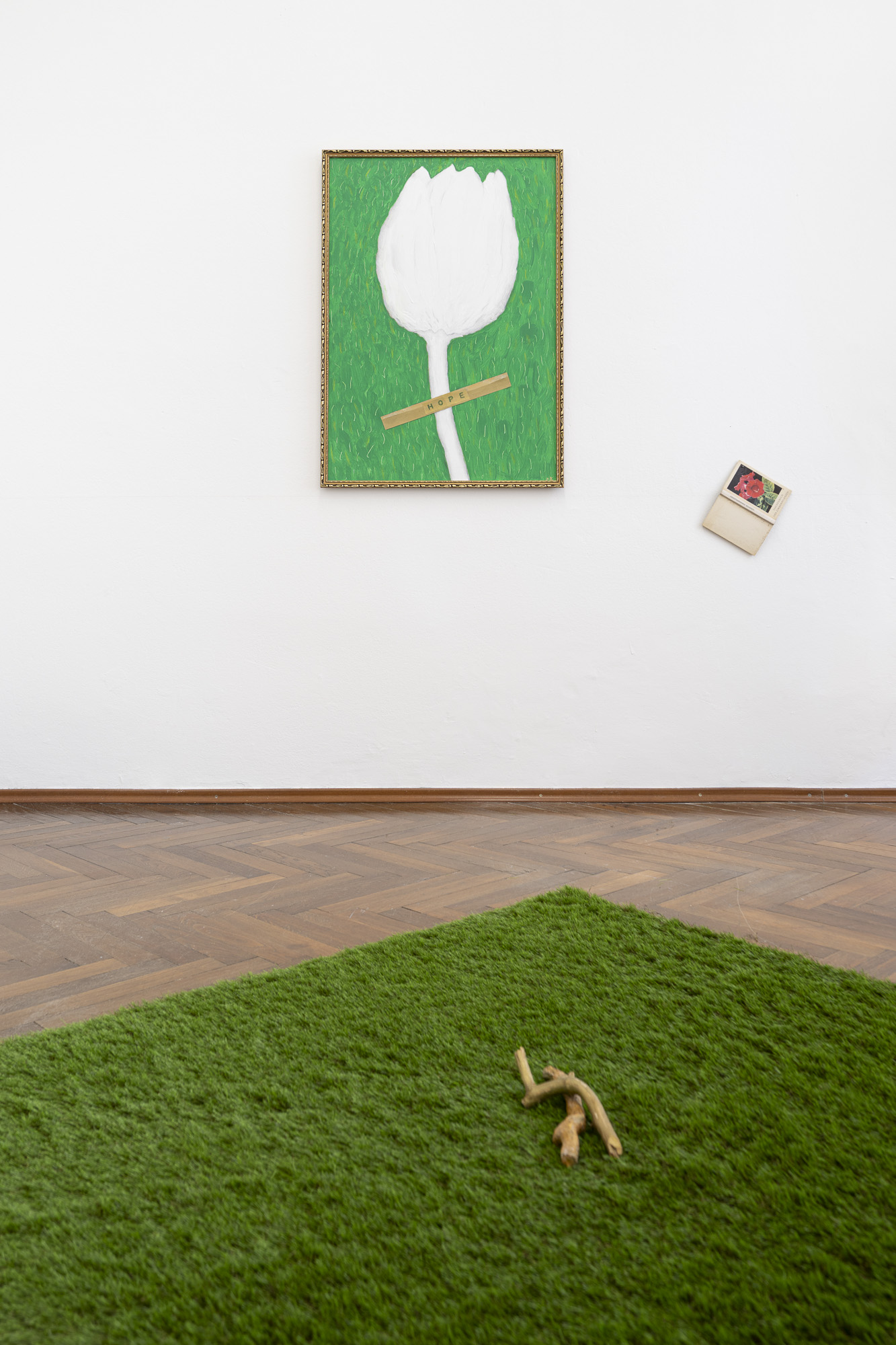
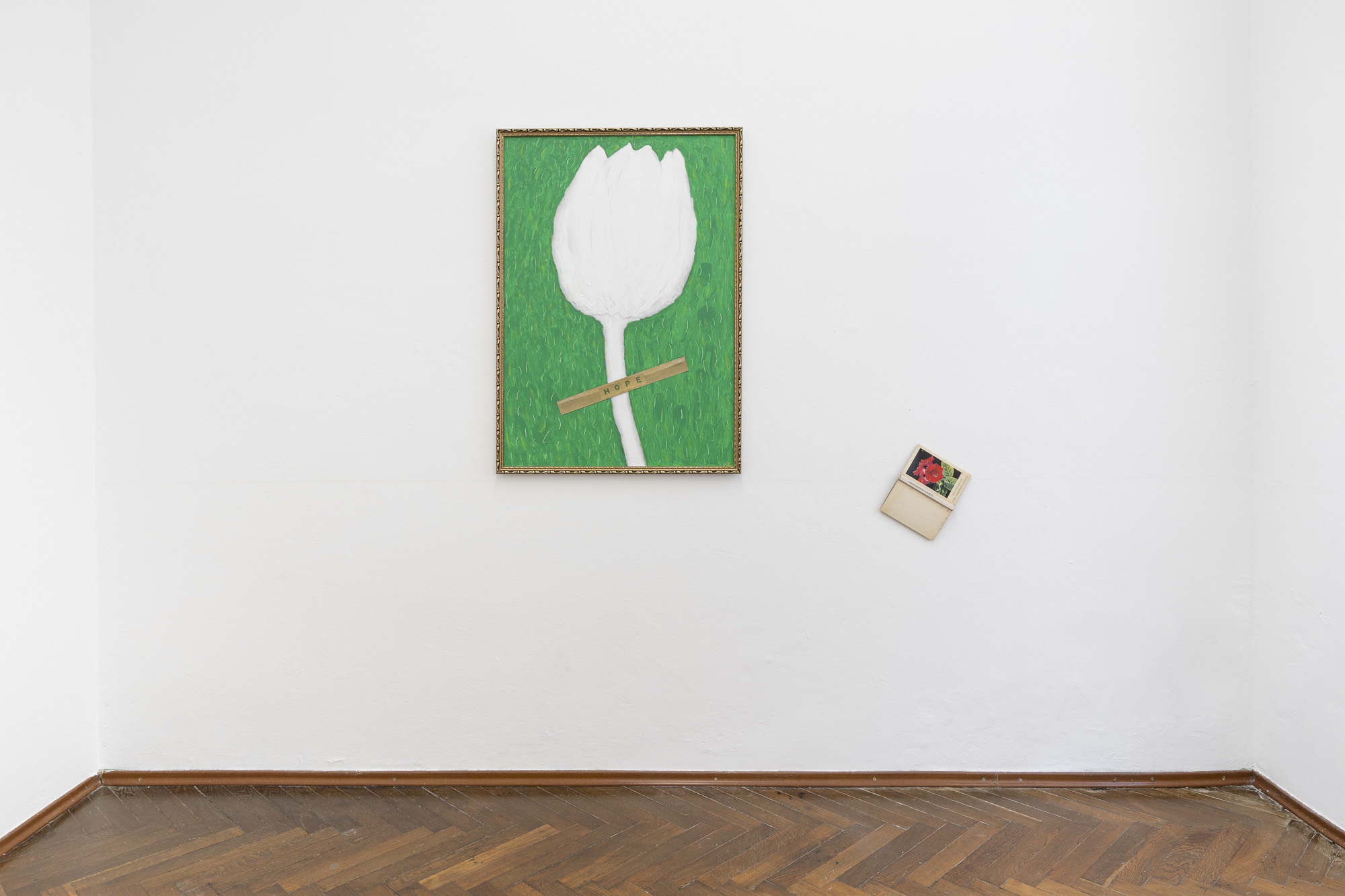
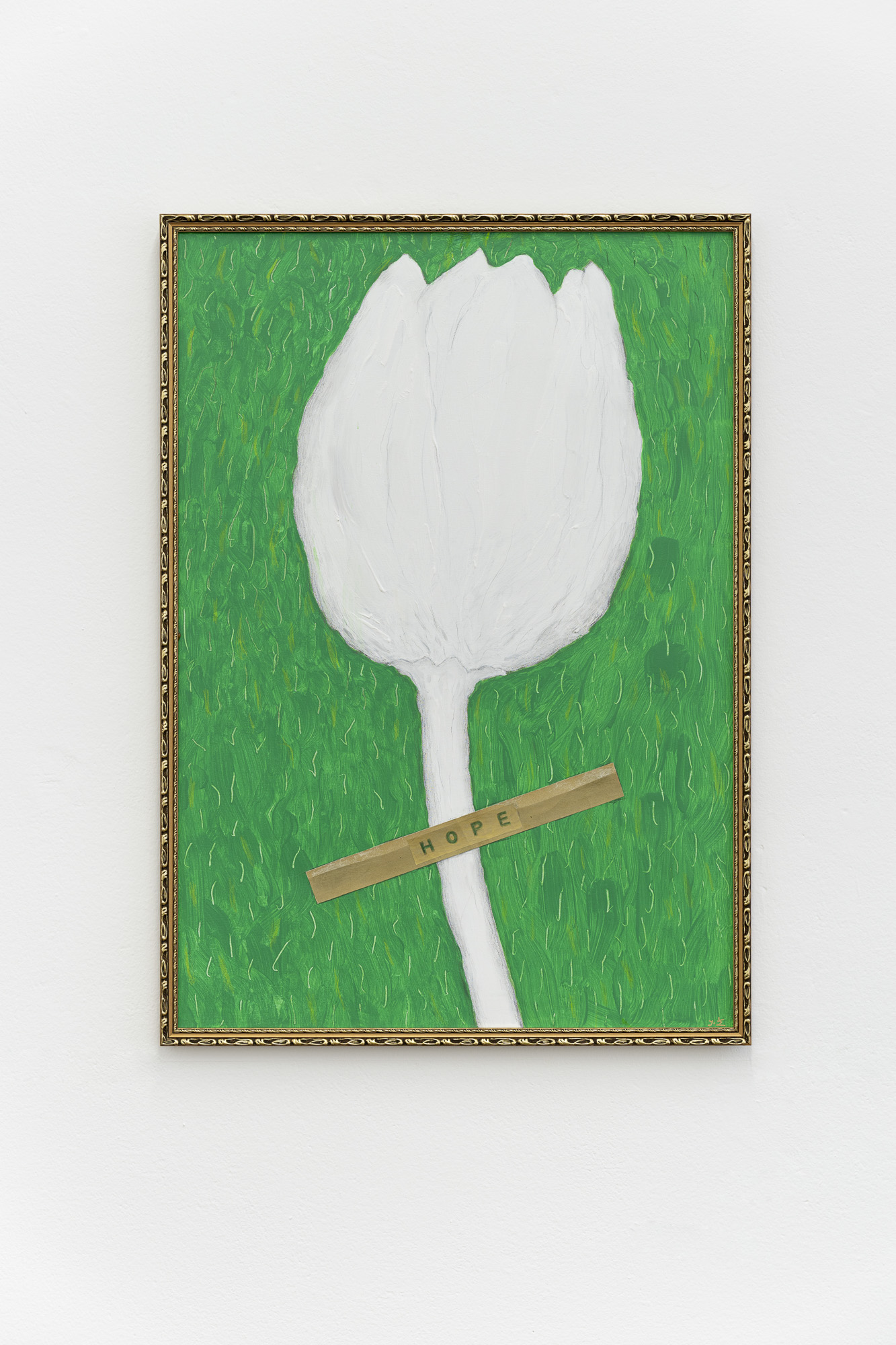
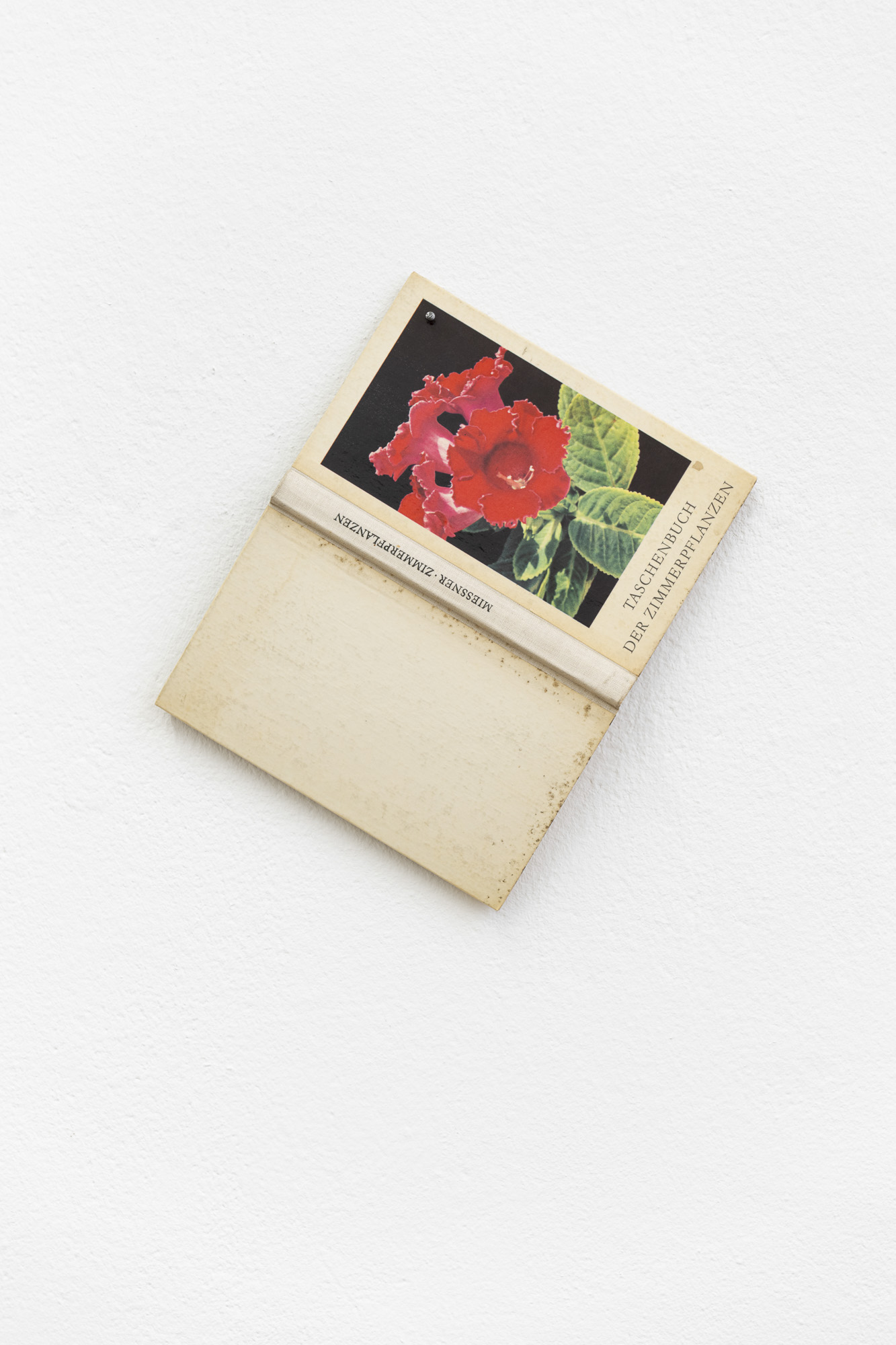
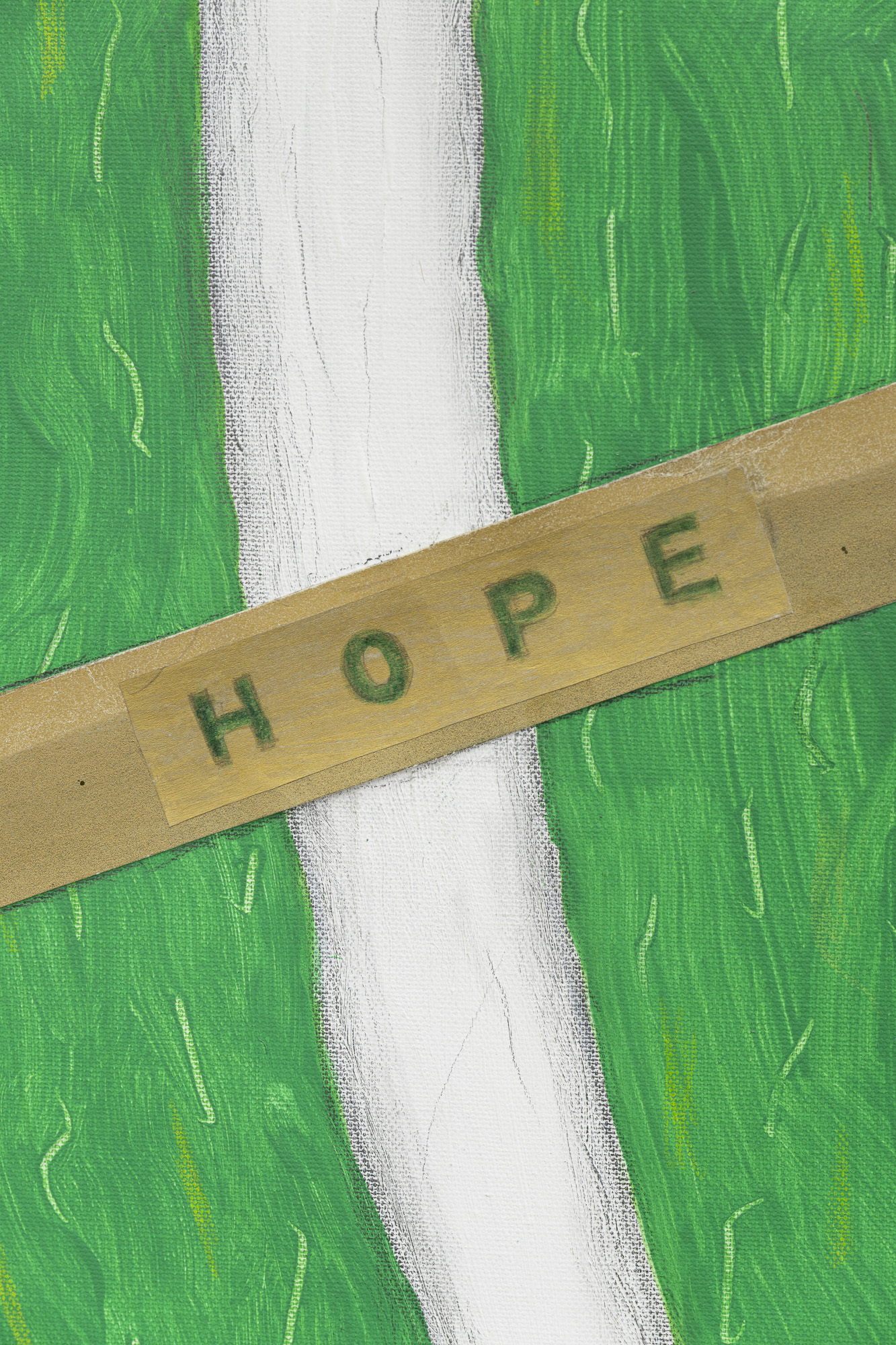
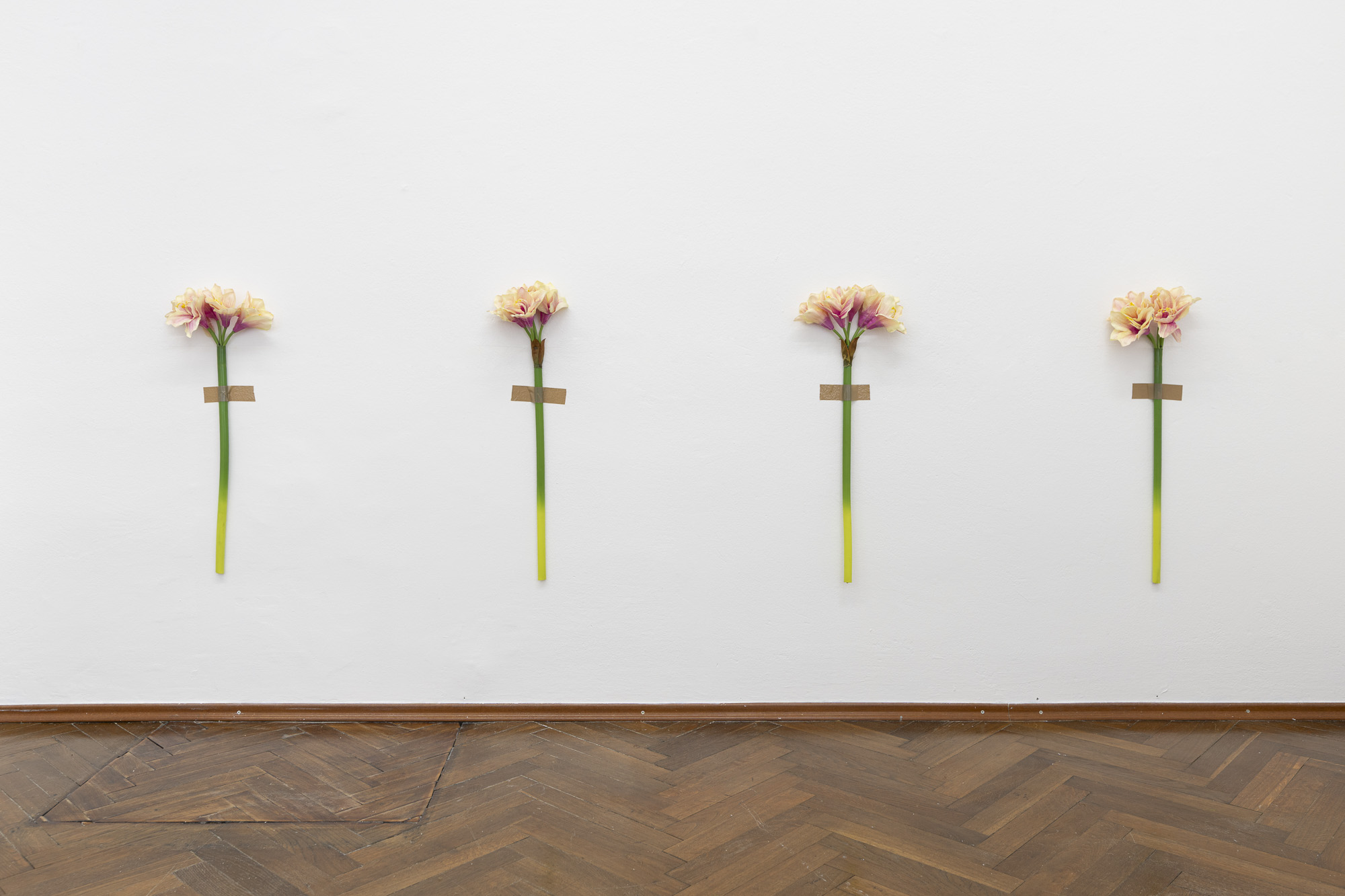
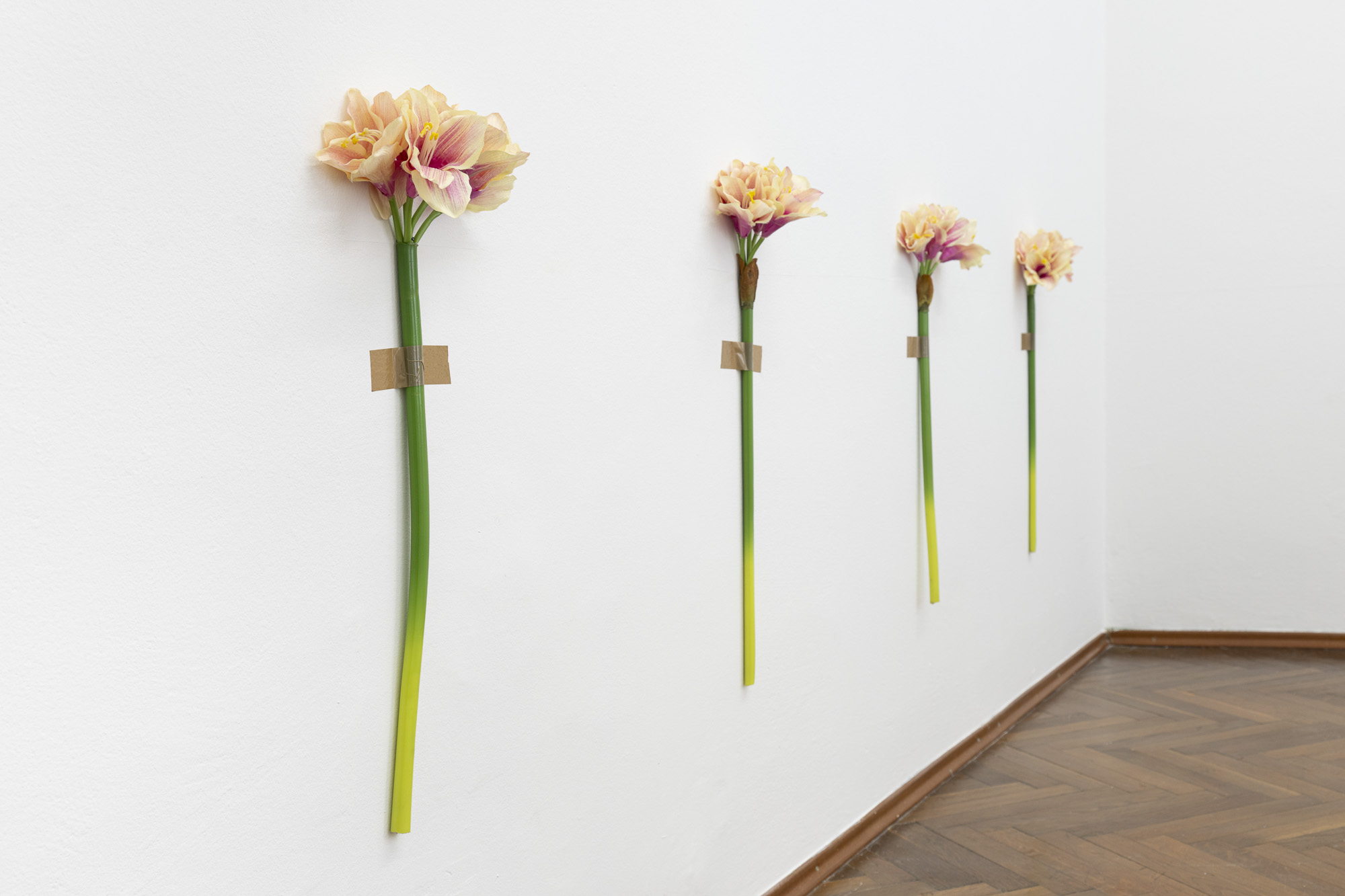
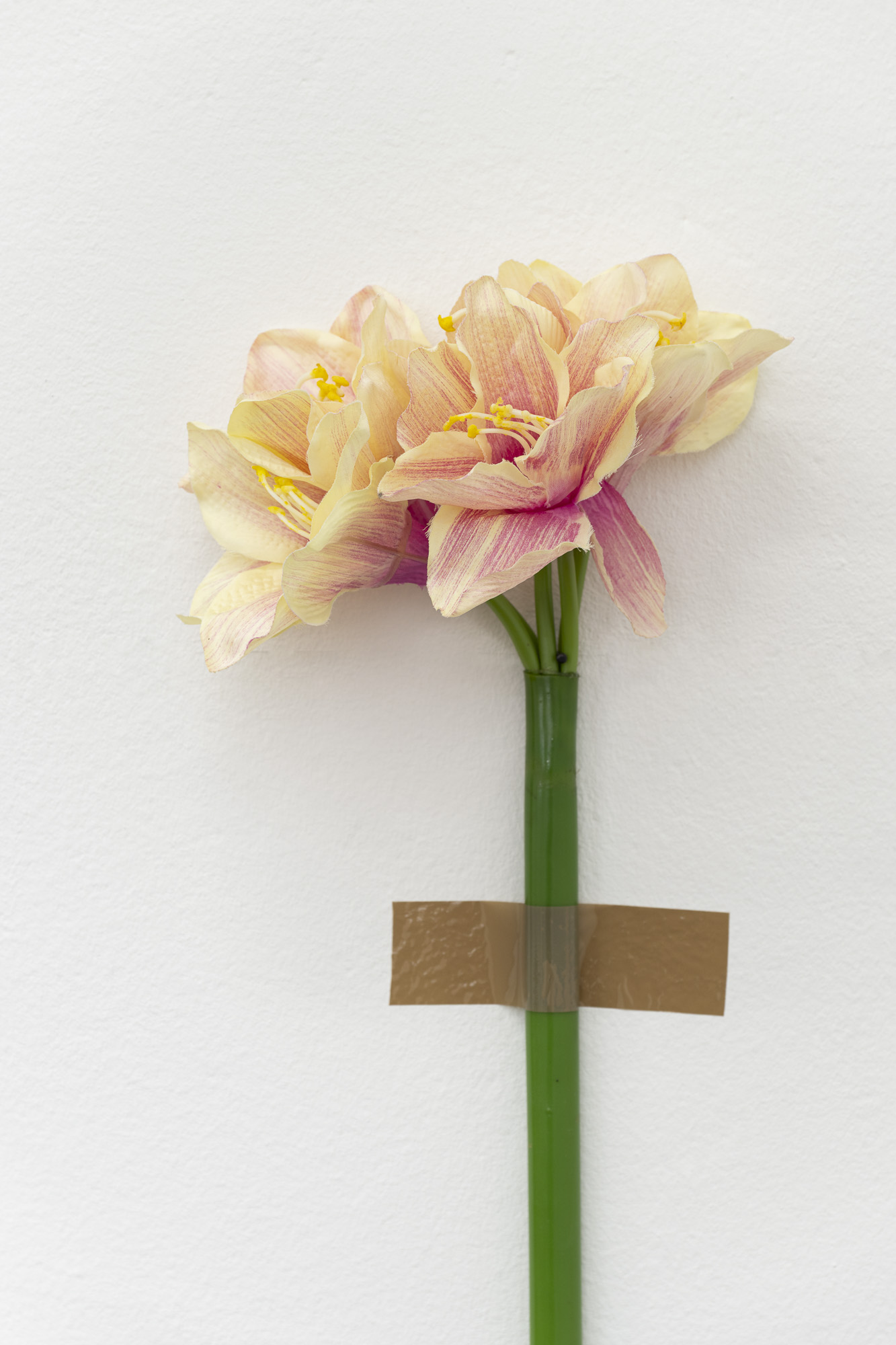
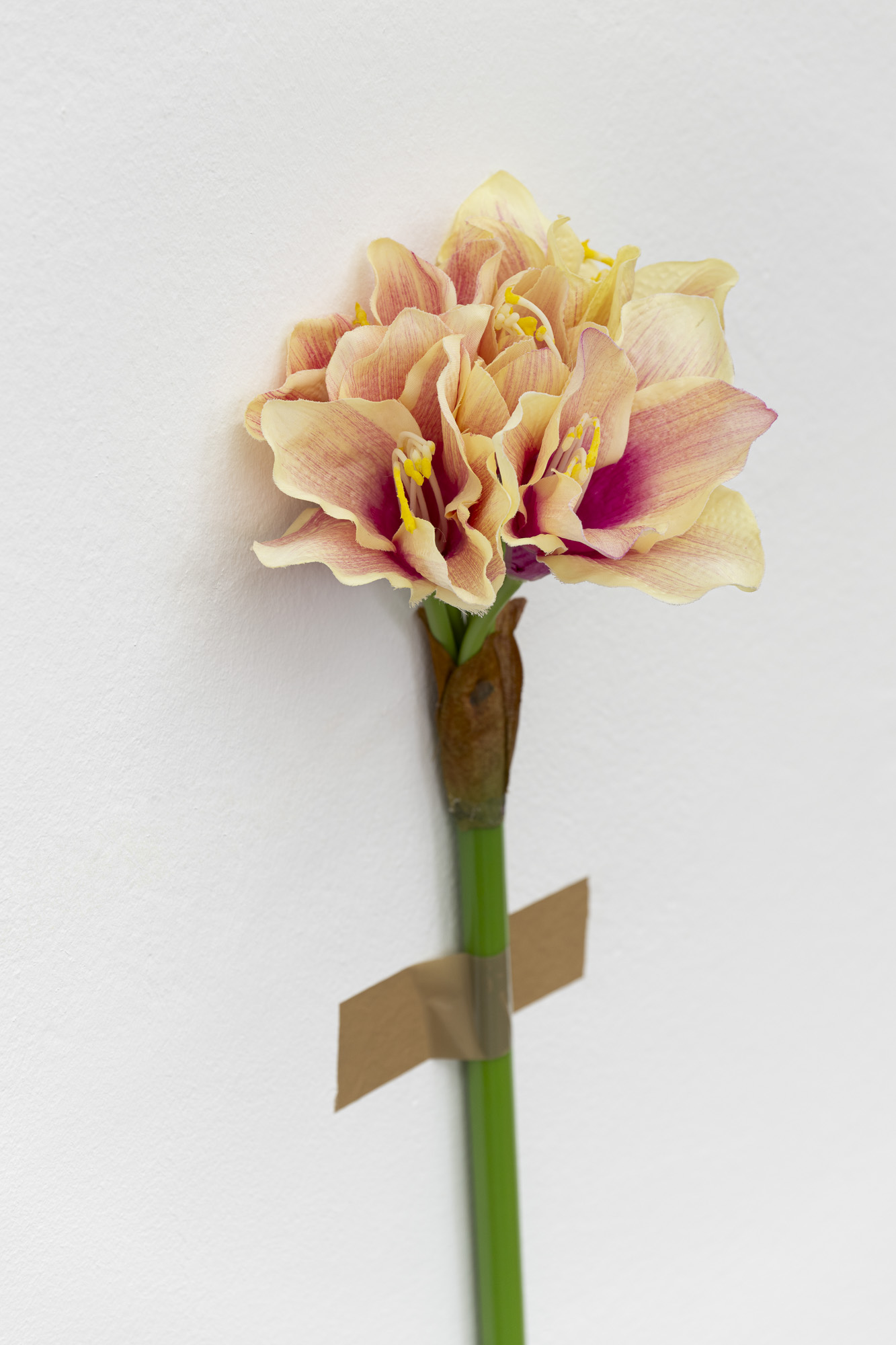
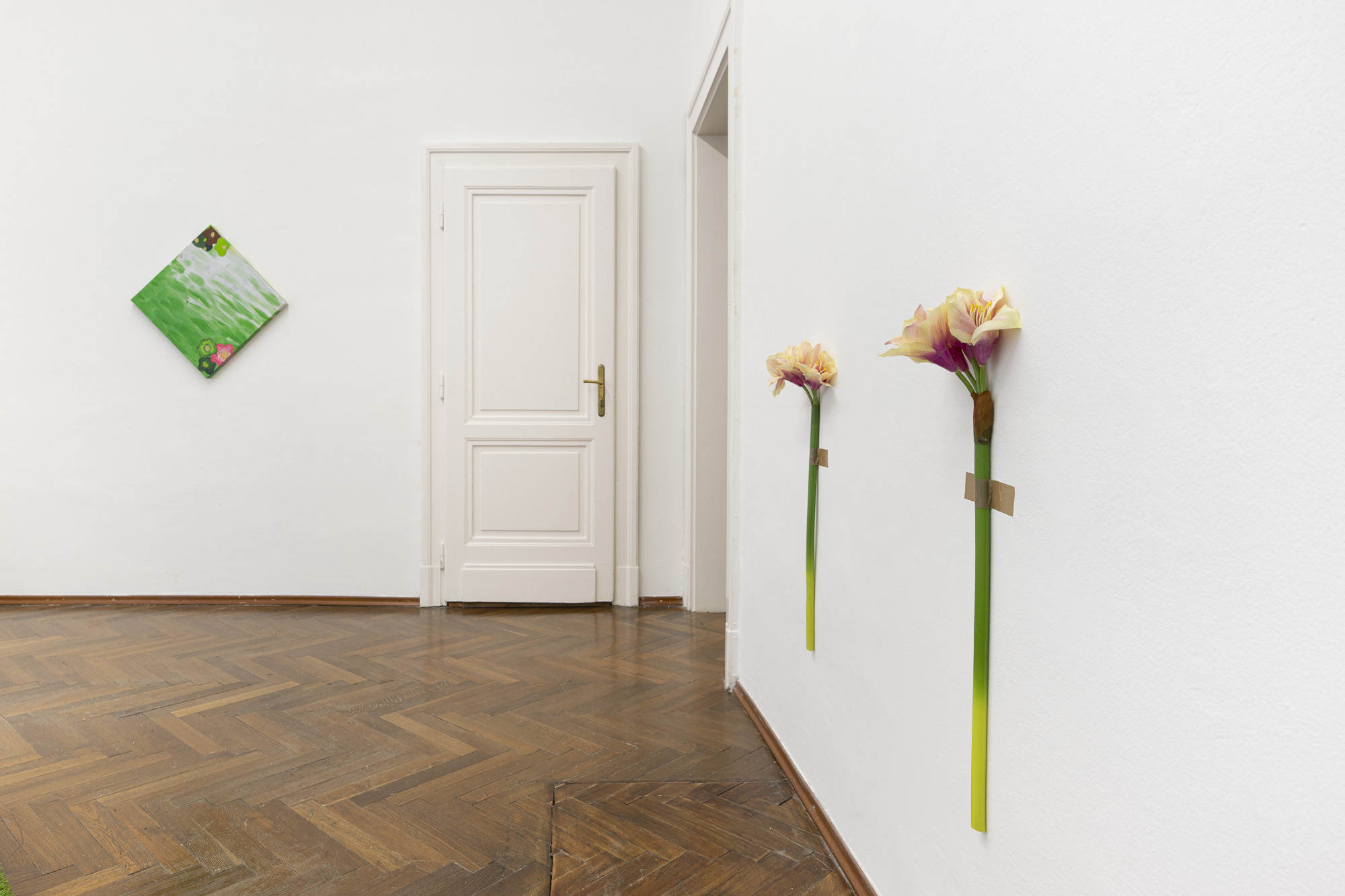
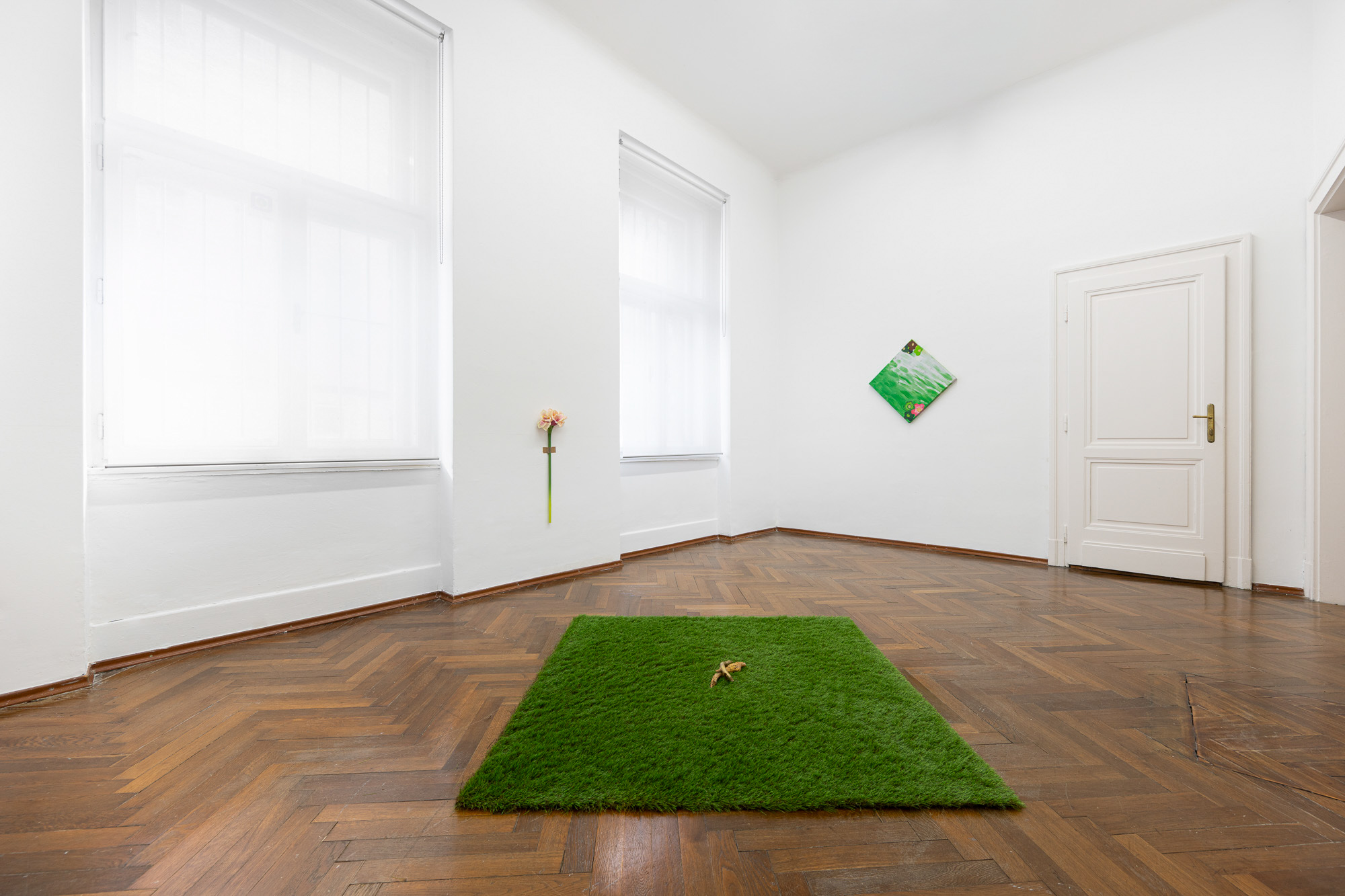
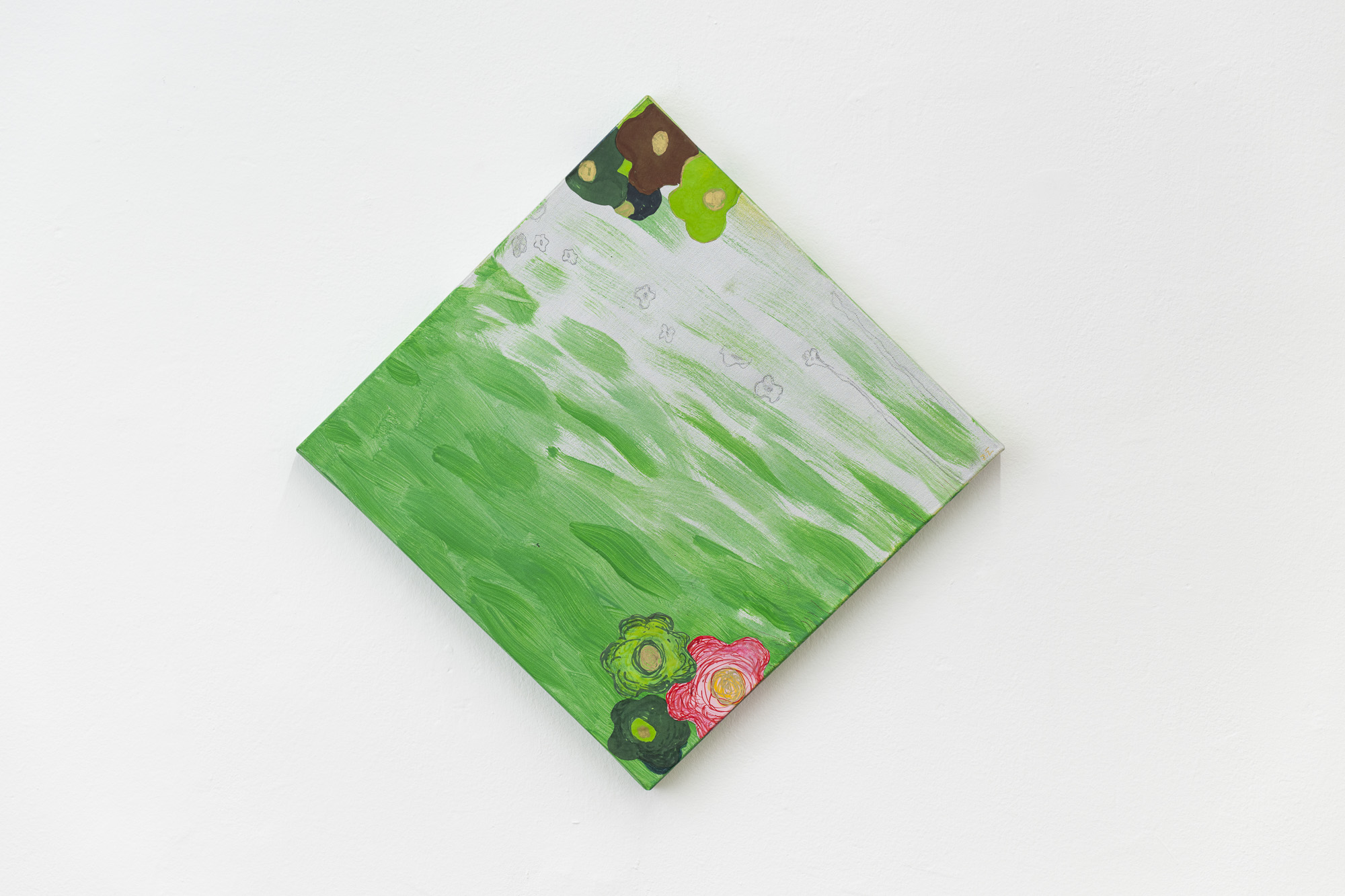
The green room carries the energy of hope. It germinates from the sediments of lived experience, from the bottom of Pandora’s box of evil and decomposition. In Želibská’s work, the flower has a long genealogy as an erotic, corporeal, feminine, feminist, and political sign with multiple layers of meaning. Here, the flowers symbolize hope’s renewing eternity and its immortal beauty. In this room, hope takes shape as a force of cultivation. It grows out of knowledge and experience. The future does not arise outside crisis, but from the process of coming to terms with it — from the capacity to preserve sensitivity, cultivate values, and open a new space for meaning even in difficult times.
Jana Želibská has created an environment that seems to think and feel at once. It does not present the current cultural situation in Slovakia and in the world descriptively, but condenses it into images that speak of memory and of the horizon of the future. Despair and hope appear here as two motifs of the same composition, two affects of the same reality. Hope is in our hands — as an active, conscious, and shared practice of care.
Lucia Gregorová Stach
Art historian and curator, currently working at the Slovak Academy of Sciences and the Academy of Arts in Banská Bystrica
March 2026
[1] Cf. Susan Best, Visualizing Feeling: Affect and the Feminine Avant-Garde. London: I.B. Tauris, 2011.
[2] The plaster bust used in the installation Amateur contra Renaissance (1989) and in the “sister” object in the current exhibition is a copy of the Parisian reliquary bust known as Constancia, now housed in the Louvre, not a copy of the Levoča bust of Cecilia Gonzaga attributed to the Renaissance sculptor Donatello, to which it bears a close resemblance. Art historian Marta Herucová has summarized the history of the scholarly evaluation of the Parisian original, from its acquisition by the Louvre in 1888, through Oronzio Lelli’s plaster cast of 1894, to later reassessments of its authorship and dating. Lelli belonged to the important Florentine makers of plaster casts and replicas after antique and Renaissance models; he also produced casts after works by Donatello and works attributed to him. The Levoča bust in Carrara marble, whose art-historical significance was opened precisely by Marta Herucová’s research, differs from this type in both size and details of modelling. Želibská therefore does not work with the literal identity of the two objects, but with a symbolic transfer between them. The figure of the “sister” allows her to connect historical female imagery, cultural memory and the current struggle over the interpretation, value and protection of culture in Slovakia.
[3] Following the public presentation of Marta Herucová’s research and during preparations for the public display of the work in 2025, the Levoča Cecilia Gonzaga was “abducted” from Levoča by representatives of the Slovak Ministry of Culture and spent 94 days in a government storage facility of the Centre for Security-Technical Activities in Topoľčianky. It was subsequently returned together with an expert opinion commissioned through the Ministry, according to which it should be considered a work from the late nineteenth century, classified as an “intentional forgery”. This report, however, represents one scholarly opinion by an Italian professor, rather than the definitive closure of the whole case. In itself, it does not annul the complexity of the hypothesis opened by Marta Herucová’s long-term research, nor the broader field of historical, material, stylistic and cultural relations that her research has made accessible.
Slovak text [ PDF ]
List of works [ PDF ]
Artist presentation [ PDF ]
Exhibition review [ ARTALK online magazine ]
The private is political: a militant art in the Verbund collection. [ online magazine article ]
Jana Želibská (1941, Olomouc, Czechoslovakia), visual artist living and working in Bratislava, play a key role on Slovak artistic scene from the end of the Sixties. She studied at the Academy of Fine Arts and Design in Bratislava and she started her artistic and exhibition career in 1967 with the exhibition Možnosť odkrývania (Possibility of uncovering) at Gallery of Cyprián Majerník in Bratislava. During the following year she spent several months in a residency program in Paris, but she returned back to already occupied Czechoslovakia. Despite this fact, her exhibition activity was and still continues to be very rich. Her work was exhibited in many Slovak, as well as foreign institutions: Tate Modern (London), Walker Art Center (Minneapolis), Ludwig Muzeum (Budapest), Zacheta – Narodowa Galeria Sztuky (Warsaw), Museum moderner Kunst Stiftung Ludwig (Vienna), Gosudarstvennyj centre sovremennovo iskusstva (Moscow), Space Apollonia (Strasbourg), Muzeul National de Arta Contemporana (Bucharest), Centre tchèque (Paris), Embassy of the Slovak Republic (Washington D. C.), Museum moderner Kunst Stiftung Wörlen (Passau), Národní galerie v Praze (Prague), XLVIII. Biennale di Venezia, Czechoslovak pavilion, Giardini di Castello (Venice), Courtyard Gallery (New York), Musée d´Art Moderne de la ville de Paris (Paris), Museo Universitario (Mexico) and others.